1 vs. 2 Stage Air Compressor: Which Setup Fits Your Workshop?
Choosing between single and dual stage compression defines your shop's peak pneumatic output, thermal efficiency, and overall operational reliability under heavy continuous workloads.

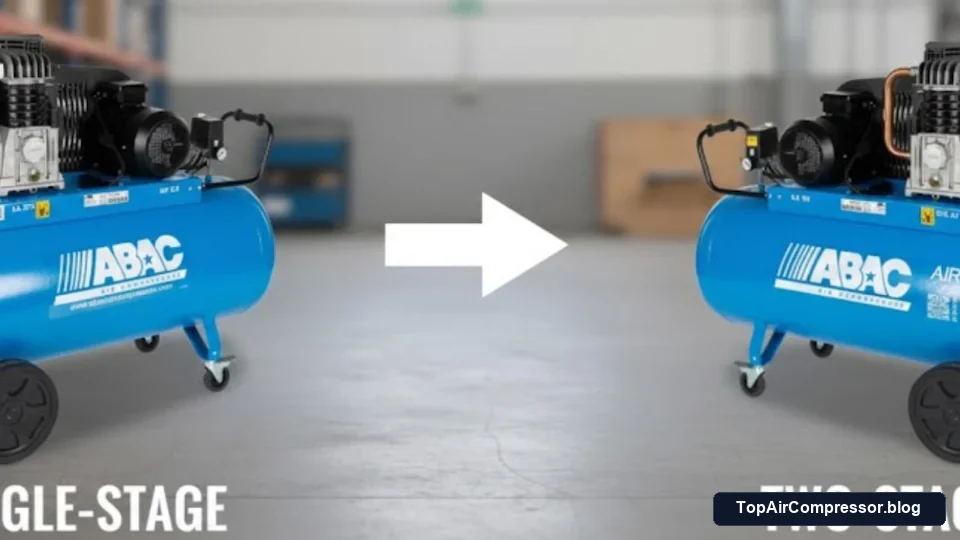
Select a single-stage compressor for standard automotive service and intermittent tool use. Deploy a two-stage compressor for industrial manufacturing, heavy sandblasting, and continuous high-pressure pneumatic demands.
Compare all top models in our Best Air Compressor: Top Picks for Every Garage & Roadside.
Side-by-Side Breakdown
| Criteria | 1 | 2 Stage Air Compressor | Edge |
|---|---|---|---|
| Peak Performance & Output | Up to 135-150 PSI maximum pressure | Up to 175-250 PSI maximum pressure | 2 Stage Air Compressor |
| Duty Cycle & Consistency | 50% to 60% standard operating duty cycle | 80% to 100% continuous industrial duty cycle | 2 Stage Air Compressor |
| Operating Noise & Vibration | Higher decibel output due to rapid strokes | Lower vibration with balanced multi-cylinder setups | 2 Stage Air Compressor |
| Portability & Footprint | Compact vertical or portable wheelbarrow builds | Heavy stationary vertical or horizontal tanks | 1 |
| Maintenance & Service Life | Simpler valve plates and fewer components | Complex intercoolers requiring strict inspection | 1 |
| Power Requirements | Runs efficiently on standard 115V or 230V lines | Demands dedicated heavy-duty 230V or 460V circuits | 1 |
| Best Ideal Use-Case | Garages, body shops, and nailing applications | Commercial auto shops and production assembly lines | 2 Stage Air Compressor |
Thermodynamic Fundamentals and Compression Mechanics
Understanding thermodynamic principles helps technicians grasp why compressor stages matter. Single-stage pumps draw ambient air and compress it once directly into the storage receiver tank.
This direct single compression stroke generates immense heat. As pressure rises inside the single cylinder, volumetric efficiency drops significantly due to extreme operating temperatures.
Conversely, dual-stage pumps utilize two distinct cylinders of varying sizes. The large low-pressure piston feeds pre-compressed air into a smaller high-pressure piston for final delivery.
Single-stage compressors draw atmospheric air directly into the cylinder, compressing it to the final pressure in one stroke. This adiabatic process generates rapid temperature spikes that challenge internal valve longevity during continuous industrial operation.
When upgrading your shop equipment, exploring options like our best two stage air compressor recommendations helps balance workload between a low-pressure piston and a high-pressure cylinder safely.
Understanding these foundational gas laws helps technicians select the right equipment. Boyle's law dictates that reducing volume increases pressure, but managing the associated thermal energy separates reliable reciprocating compressors from failing units.
- Single-stage pumps complete compression in one direct stroke.
- Two-stage architecture splits the workload across two unique pistons.
- Lower mechanical stress extends the lifespan of dual-stage internal valves.
Single Stroke Mechanics Explained
Single-stage units rely on simplicity and direct piston displacement. Air enters the intake valve, undergoes one compression cycle, and exits straight to the check valve.
This design minimizes internal mechanical friction points. However, it limits the maximum attainable working pressure without causing thermal breakdown of the lubricating oil.
- Single intake and exhaust valve configuration.
- Direct cylinder cooling via external cast iron fins.
Volumetric Efficiency and Pressure Thresholds
Pressure capacity serves as the primary dividing line between these compressor classes. Upgrading to a top 60 gallon 2 stage air compressor easily surpasses the one hundred thirty five PSI single-stage limit.
Exceeding this threshold on a single-stage pump drastically reduces volumetric efficiency. Heat buildup causes air expansion, preventing the cylinder from drawing a full charge of air.
Two-stage compressors easily achieve one hundred seventy five PSI or higher. The intermediate cooling phase shrinks the air volume before the second piston finishes compression.
Volumetric efficiency drops significantly when single-stage pumps push past 100 PSI. Clearance volume expansion traps residual high-pressure air, preventing fresh intake charges from fully entering the cylinder during the subsequent suction stroke.
Two-stage configurations easily sustain operating pressures up to 175 PSI or higher by utilizing smaller secondary pistons. These smaller bores minimize clearance volume losses and maintain superior volumetric efficiency across demanding, heavy-duty industrial work shifts.
Facility engineers must evaluate their actual PSI requirements before purchasing. Selecting a system that constantly operates near its absolute maximum threshold accelerates valve reed fatigue and degrades overall pneumatic output consistency over time.
- Single-stage units suit tools operating below ninety PSI.
- Two-stage units maintain high CFM delivery at elevated pressures.
- Intermediate pressure reduction prevents thermal air expansion losses.
Pressure Drop and Volume Loss
Volumetric efficiency dictates real-world performance in professional automotive shops. When air heats up during compression, it occupies more space, reducing net cubic feet per minute.
Multi-stage compression mitigates this thermodynamic disadvantage by cooling the charge mid-cycle. This ensures consistent pneumatic delivery during prolonged high-pressure tool operations.
- Maintains high volumetric efficiency under heavy loads.
- Prevents CFM starvation during extended tool cycles.
Thermal Management and Intercooler Integration
Thermal management dictates how long equipment runs safely. Reviewing options in our best 2 stage air compressor under 1000 guide helps you avoid relying solely on basic cast-iron cooling fins.
Without an intercooler, heat accumulates rapidly within the single chamber. This limits the safe operational duty cycle to prevent oil breakdown and catastrophic valve carbonization.
Two-stage models incorporate a finned copper or aluminum intercooler tube between stages. This tube radiates ambient heat away from the air charge before second-stage entry.
Heat is the primary enemy of pneumatic longevity. Single-stage pumps lack intermediate cooling, causing discharge temperatures to routinely exceed 350 degrees Fahrenheit, which rapidly degrades lubricating oils and damages synthetic valve seals.
Two-stage systems incorporate finned tube intercoolers between the first and second cylinders. As compressed air travels through this intermediate heat exchanger, ambient airflow strips away thermal energy before the secondary compression stage begins.
Lower operating temperatures dramatically extend compressor life. Cooler intake air entering the high-pressure cylinder requires less mechanical work, protecting the electric motor from thermal overload while reducing downstream moisture accumulation in storage tanks.
- Intercoolers drastically lower inter-stage operating temperatures.
- External cooling fins prevent premature lubricating oil breakdown.
- Enhanced thermal control enables continuous industrial duty cycles.
Intercooler Engineering Dynamics
The intercooler tube acts as a vital thermal radiator between cylinders. Passing ambient air across these fins drops the temperature of the pre-compressed air significantly.
Cooler air is denser, allowing the second-stage piston to compress more mass efficiently. This engineering feat reduces total power consumption per cubic foot delivered.
- Copper and aluminum tubing maximize thermal conductivity.
- Reduces thermal stress on the high-pressure reed valves.
Power Demands, Electrical Requirements, and Motor Sizing
Electrical infrastructure requirements often dictate workshop installations. Choosing a unit from our best 60 gallon single stage air compressor selections ensures compatibility with standard one hundred fifteen volt household circuits.
Larger single-stage and entry dual-stage units require dedicated two hundred thirty volt single-phase lines. Industrial two-stage systems frequently demand three-phase electrical service.
Starting torque and running amperage increase substantially with two-stage pumps. Facilities must verify breaker panel capacity and wire gauge thickness before final installation.
Electrical demands scale directly with compressor displacement and operating pressure. A standard single-stage unit typically runs on 115V or 230V single-phase power, making it suitable for standard commercial workshops and residential garage environments.
Larger two-stage models frequently require heavy-duty 230V or 460V three-phase power to start and run properly. Motor starters, magnetic contactors, and thermal overload relays are essential components required to handle heavy starting currents safely.
Failing to match electrical infrastructure with compressor amperage draws causes frequent breaker trips and premature motor winding failure. Always consult a licensed electrician to verify panel capacity before installing high-horsepower shop compressors.
- Verify amperage draws before commissioning heavy compressors.
- Three-phase power reduces motor strain in commercial environments.
- Proper magnetic starter installation protects against thermal overload.
Voltage and Amperage Considerations
Running high-horsepower motors requires robust electrical infrastructure. Voltage drop across long extension cords will quickly overheat and ruin electric compressor windings.
Hardwired connections with proper thermal overload protection are mandatory for industrial setups. Consulting a licensed electrician prevents costly equipment damage during startup.
- Never use undersized extension cords on compressors.
- Install dedicated breakers matching motor nameplate specs.
Duty Cycles, Air Delivery, and Continuous Workloads
Duty cycle ratings determine how long a compressor pump can run within a given timeframe. Single-stage units typically feature a fifty percent duty cycle, resting half the time.
Pushing a single-stage pump beyond its thermal limit causes excessive wear. Reed valves warp, oil viscosity thins out, and moisture accumulates heavily inside the receiver tank.
Two-stage industrial compressors achieve an eighty to one hundred percent continuous duty cycle. They are engineered to run all day without overheating or losing pressure.
Duty cycle ratings dictate how long a compressor can run safely within a given timeframe. Standard single-stage units usually feature a 50 percent duty cycle, requiring equal run and rest periods to dissipate internal heat.
Industrial two-stage compressors often deliver a 100 percent continuous duty cycle when paired with adequate ventilation and proper oil levels. They run indefinitely without overheating, satisfying demanding assembly lines and auto body shops.
Evaluating CFM output alongside pressure ratings prevents workflow bottlenecks. Ensure your chosen compressor delivers at least twenty percent more CFM than your highest-consuming pneumatic tool requires at its specified operating pressure threshold.
- Match your shop CFM requirements to the correct duty cycle.
- Continuous duty systems prevent workflow bottlenecks in production.
- Intermittent duty models suit general automotive and hobbyist tasks.
Evaluating CFM Requirements
Calculating total air consumption prevents buying an underpowered machine. Sum the CFM requirements of all air tools running simultaneously in your workspace.
Always add a twenty percent safety margin to your CFM calculations. This ensures your chosen compressor never struggles to keep up with peak demand.
- List every pneumatic tool air consumption rating.
- Account for simultaneous tool usage in busy shops.
Footprint, Portability, and Installation Constraints
Physical dimensions and weight heavily influence shop layout decisions. Single-stage compressors are frequently mounted on portable wheeled carts or horizontal tanks.
This portability allows mobile mechanics and contractors to transport units easily. Stationary vertical single-stage models also occupy minimal floor space in tight home garages.
Two-stage compressors are heavy, stationary industrial titans. They require bolt-down floor installation on concrete pads to absorb vibrational forces during heavy operation.
Physical dimensions dictate where and how compressors can be deployed safely. Portable single-stage wheeled units offer excellent job-site maneuverability, allowing contractors to move equipment easily across uneven framing and remodeling work environments.
Two-stage compressors are typically large, heavy vertical or horizontal stationary ASME tanks designed for permanent floor mounting. Their substantial weight and rigid construction demand solid concrete foundations to isolate destructive operating vibrations.
Ventilation clearance is another critical installation constraint often overlooked by facility managers. Air-cooled compressors require adequate perimeter space to exhaust heat efficiently and prevent thermal shutdown events during peak summer weather conditions.
- Portable units offer flexibility for jobsite contractors.
- Stationary vertical tanks save valuable floor space.
- Industrial two-stage units demand vibration-isolation pads.
Stationary vs Portable Mounting
Choosing between stationary and mobile setups depends on workflow habits. Stationary units accommodate larger storage tanks and eliminate wheel maintenance headaches.
Mobile compressors provide unmatched versatility for field service trucks. However, their smaller tanks cycle more frequently under heavy loads.
- Check floor weight capacities before installation.
- Ensure adequate clearance for routine maintenance access.
Maintenance Protocols, Wear Patterns, and Long-Term Durability
Routine maintenance preserves compressor longevity and ensures safe daily operation. Single-stage systems feature fewer internal parts, simplifying annual valve inspections and oil changes.
Two-stage pumps require meticulous attention to intercoolers, inter-stage safety valves, and oil levels. Neglecting maintenance on dual-stage systems leads to catastrophic mechanical failure.
Using synthetic compressor oil extends service intervals significantly for both types. Regular moisture drainage from air receiver tanks prevents internal rust perforation.
Routine maintenance ensures long-term reliability and prevents catastrophic pump failures. Single-stage units demand frequent reed valve inspections and synthetic oil changes every few hundred operating hours to combat high internal operating temperatures.
Two-stage pumps distribute mechanical stress more evenly, resulting in exceptionally long service intervals. However, technicians must routinely check intercooler fins, safety pressure relief valves, and centrifugal unloader mechanisms for proper mechanical movement.
Tracking operating hours helps maintenance teams schedule proactive overhauls before components seize. Investing in high-grade compressor lubricants and changing inlet filter elements on schedule significantly preserves piston ring integrity and cylinder wall finishes.
- Change compressor oil every three hundred operating hours.
- Inspect valve plates annually for carbon buildup or wear.
- Drain tank condensate daily to prevent internal corrosion.
Preventative Care Best Practices
Establishing a strict preventative maintenance schedule guarantees maximum equipment lifespan. Check air filter elements monthly to prevent abrasive dust from entering cylinders.
Monitor belt tension regularly to avoid slipping and premature motor wear. Keeping detailed service logs ensures warranty compliance and reliable pneumatic output.
- Clean inlet filter elements on a monthly basis.
- Check drive belt deflection and alignment quarterly.
Frequently Asked Questions
What is the primary difference between 1 and 2 stage air compressors?
Single-stage compressors compress air once directly into the tank, while two-stage compressors use two separate cylinders to compress air incrementally for higher pressure and efficiency.
Can a single-stage compressor run a sandblaster or DA sander?
High-demand tools like sandblasters require continuous high CFM delivery. A two-stage compressor is strongly recommended for these continuous industrial applications to prevent pressure drops.
Do two-stage compressors require special electrical wiring?
Most industrial two-stage units require dedicated heavy-duty 230V or 460V circuits. You must verify your facility electrical panel capacity before purchasing a high-horsepower model.
Why do two-stage compressors run cooler than single-stage units?
Two-stage pumps feature an intermediate intercooler tube. This tube radiates heat away from the air charge between compression stages, improving overall thermal efficiency significantly.
Which compressor type offers a longer operational lifespan?
Industrial two-stage compressors generally last longer under heavy use because their workload is split across multiple pistons, resulting in lower mechanical stress and wear.