Air Compressor Steel vs. Aluminum Tank: Which Fits Your Setup Better?
Selecting the right tank material balances structural rigidity against mobility demands. Understanding these core engineering properties prevents premature vessel failure.

Choose Steel for stationary industrial shops requiring maximum durability, or select Aluminum for mobile service trucks needing reduced vehicle payload and corrosion resistance.
Compare all top models in our Best Air Compressor: Top Picks for Every Garage & Roadside.
Side-by-Side Breakdown
| Criteria | Air Compressor Steel | Aluminum Tank | Edge |
|---|---|---|---|
| Peak Performance & Output | Handles high pressure effortlessly | Matches pressure with proper wall thickness | Tie |
| Duty Cycle & Consistency | Retains structural rigidity under cyclic fatigue | Flexes slightly more under high cyclic loads | Air Compressor Steel |
| Operating Noise & Vibration | Dampens sound waves effectively due to mass | Tends to resonate slightly more at high frequencies | Air Compressor Steel |
| Portability & Footprint | Heavier overall footprint requiring assistance | Significantly lighter for effortless single-person transport | Aluminum Tank |
| Maintenance & Service Life | Vulnerable to internal rust if drained poorly | Naturally resists oxidization and moisture degradation | Aluminum Tank |
| Power Requirements | Standard motor pairing requirements | Standard motor pairing requirements | Tie |
| Best Ideal Use-Case | Stationary automotive repair and fabrication shops | Mobile service vehicles and outdoor job sites | Split |
Metallurgical Composition & Structural Integrity
Carbon steel tanks utilize heavy-gauge alloy plates rolled and welded under strict industrial guidelines. This traditional manufacturing process delivers exceptional tensile strength capable of withstanding extreme continuous pressures.
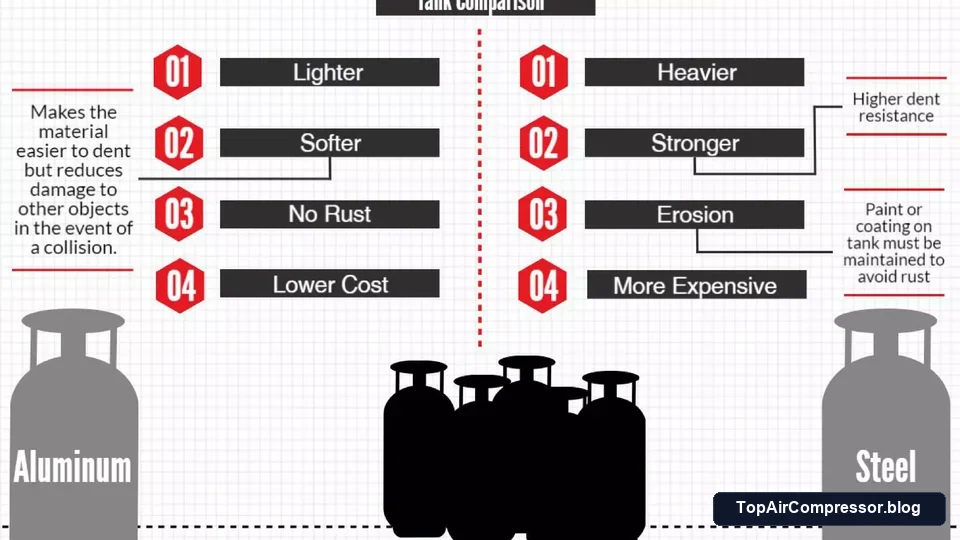
Aluminum alloy tanks rely on specialized marine-grade metallurgy to achieve comparable burst strength. Engineers must increase wall thickness slightly to match the inherent rigidity found in standard steel vessels.
Steel tanks use high-carbon alloys yielding high tensile strength near 70,000 PSI. This lets engineers design thinner vessel walls while handling severe cyclical fatigue during daily pneumatic operations.
Aluminum variants rely on 6061-T6 marine-grade alloys offering lower tensile ratings around 42,000 PSI. Manufacturers compensate by increasing wall thickness, which maintains burst pressure thresholds but alters overall receiver weight.
- Carbon steel offers superior tensile strength out of the box.
- Aluminum uses specialized alloys to maintain structural integrity.
- Wall thickness varies significantly between the two materials.
Tensile Strength & Yield Tolerances
Yield strength dictates how much internal pressure a vessel tolerates before permanent deformation occurs. Steel traditionally exhibits a higher threshold for sudden pressure spikes without structural compromise.
Aluminum yields differently under stress, requiring robust engineering designs to prevent fatigue cracking near welded seams during long-term operational cycles.
- Yield strength defines permanent deformation limits.
- Steel handles sudden pressure spikes exceptionally well.
Weight Distribution & Jobsite Portability
Weight remains a pivotal factor when transporting compressed air systems between active job sites. Lighter receivers make maintenance easier when following guides on how to check air compressor tank for rust safely.
Aluminum construction slashes total equipment weight by up to forty percent. Contractors loading units daily benefit immensely from this drastic reduction in physical strain.
Steel receiver tanks add significant dead weight to portable compressor assemblies, often requiring dual-wheel pneumatic carts. Operators lifting units into service trucks face heavy ergonomic strain and potential musculoskeletal fatigue over time.
Aluminum alloy reservoirs reduce total equipment weight by up to forty percent compared to steel equivalents. This reduction transforms heavy wheelbarrow units into easily manageable systems for single-person loading tasks.
- Steel adds substantial dead weight to service vehicles.
- Aluminum reduces system weight by up to forty percent.
- Mobile contractors experience less physical fatigue.
Ergonomic Impact on Field Technicians
Lifting heavy steel units into truck beds increases the risk of chronic back injuries among service technicians. Ergonomic compliance heavily favors lightweight aluminum alternatives.
Reducing equipment mass also improves vehicle fuel economy over thousands of miles of service route driving across regional territories.
- Heavy steel lifting raises workplace injury risks.
- Lighter tanks improve overall service vehicle fuel economy.
Corrosion Resistance & Internal Moisture Dynamics
Compressing atmospheric air inevitably introduces moisture into the pressure vessel through condensation. Steel tanks demand rigorous daily draining to prevent aggressive internal rust formation.
Aluminum forms a passive oxide layer upon atmospheric exposure, halting further corrosion instantly. This natural defense protects the vessel from internal moisture accumulation.
Compressed air naturally generates condensate containing dissolved oxygen and corrosive acids. Steel vessels require internal epoxy coatings alongside how to remove water from air compressor tank steps to prevent structural wall pitting.
Aluminum naturally forms a passivating protective oxide layer that halts internal oxidation upon contact with ambient oxygen. This chemical property eliminates rust flaking that typically clogs downstream pneumatic regulator valves.
- Condensation introduces constant moisture into storage tanks.
- Steel requires strict daily draining schedules to prevent rust.
- Aluminum creates a natural protective oxide layer.
Mitigating Condensation Damage in Humid Climates
Humid coastal environments accelerate external and internal corrosion rates exponentially. Steel compressors deployed in these regions require specialized epoxy interior coatings for longevity.
Aluminum thrives in high-humidity environments without requiring secondary protective internal linings, simplifying long-term maintenance protocols for facility managers.
- Coastal humidity accelerates rust formation in steel tanks.
- Aluminum eliminates the need for special internal coatings.
Pressure Ratings & Safety Compliance Standards
Regulatory bodies like ASME enforce rigorous manufacturing codes for all compressed air receivers. Both steel and aluminum models must pass hydrostatic proof testing exceeding normal operating pressures.
Certified pressure vessels display official stamps verifying compliance with safety margins. Choosing uncertified tanks introduces catastrophic failure risks during high-output operations.
Both tank materials must strictly comply with ASME Section VIII boiler and pressure vessel codes. Certification ensures safety whether operational or evaluating can you store air compressor with air in tank guidelines safely.
Steel typically accommodates higher pressure thresholds exceeding 200 PSI industrial limits without excessive wall thickness scaling. Aluminum designs often cap operating pressures lower unless manufactured with substantially thicker extrusion profiles.
- ASME codes govern all pressure vessel manufacturing standards.
- Hydrostatic proof testing verifies structural safety margins.
- Certified stamps are mandatory for industrial workplace safety.
Hydrostatic Testing & Burst Thresholds
Testing protocols subject sample tanks to pressures well above their maximum allowable working pressure. Steel usually exhibits predictable bulging before rupture occurs under extreme duress.
Aluminum handles cyclic pressure testing reliably when manufactured with strict quality control measures, ensuring safe containment of high-energy compressed air volumes.
- Proof tests exceed maximum allowable working pressures.
- Predictable failure modes protect operators from shrapnel.
Thermal Conductivity & Ambient Temperature Performance
Thermal dynamics influence how efficiently an air compressor manages internal heat buildup. Aluminum features exceptional thermal conductivity, dissipating heat much faster than dense carbon steel.
Faster heat dissipation lowers the overall temperature of compressed air entering the tank, reducing downstream moisture condensation issues significantly during heavy usage.
Aluminum features superior thermal conductivity, dissipating frictional heat from compressor pumps faster than steel. This efficiency lowers discharge air temperatures before you review how to drain water from air compressor tank maintenance procedures.
Steel retains thermal energy longer, which can exacerbate moisture condensation issues inside unconditioned jobsite environments. Operators must monitor ambient dew points closely to prevent excessive water accumulation in reservoirs.
- Thermal conductivity affects internal air temperature regulation.
- Aluminum dissipates heat much faster than heavy steel.
- Lower air temperatures reduce downstream moisture problems.
Managing Heat Dissipation in Enclosed Spaces
Enclosed compressor closets trap ambient heat, reducing overall volumetric efficiency. Aluminum tanks help radiate residual thermal energy away from the pump head faster.
Steel retains heat longer, which can elevate operating temperatures during continuous duty cycles in poorly ventilated mechanical rooms or service trailers.
- Enclosed spaces trap heat and lower volumetric efficiency.
- Steel retains thermal energy longer during continuous cycles.
Long-Term Cost Analysis & Lifecycle Value
Initial purchase costs heavily favor traditional steel tanks due to cheaper raw materials and simpler fabrication techniques. Budget-conscious operations often select steel for stationary applications.
Aluminum units command a higher upfront financial investment driven by raw material expenses. However, avoiding premature rust replacement offsets this initial cost over time.
Steel compressor tanks carry a lower initial capital expenditure, making them attractive for fixed automotive service bay installations. However, replacement cycles occur sooner due to inevitable internal rusting from neglected condensate purging.
Aluminum vessels command a steep upfront price premium driven by complex material extraction and welding protocols. Their extended service lifespan in corrosive coastal environments frequently offsets this higher initial purchasing cost.
- Steel offers a lower initial purchase price point.
- Aluminum requires a higher upfront financial investment.
- Lifecycle value depends heavily on operating environments.
Evaluating Total Cost of Ownership
Calculating total cost of ownership requires factoring in maintenance labor, coating repairs, and premature replacement schedules. Steel demands vigilant upkeep to reach its maximum lifespan.
Marine and mobile applications extract a heavy toll on steel, making aluminum the more economical choice over a ten-year operational window despite higher initial costs.
- Total cost includes maintenance labor and replacement frequency.
- Mobile applications favor aluminum for long-term economy.
Application-Specific Matching for Industrial Crews
Matching the correct tank material to your specific workload prevents costly equipment mismatches. Fixed automotive service bays benefit greatly from the sheer mass and stability of steel.
Conversely, mobile roofing contractors and roadside assistance trucks require lightweight aluminum to maintain payload limits and survive constant transit vibrations.
Fixed manufacturing plants benefit most from stationary steel tanks bolted securely to concrete workshop foundations. These units absorb heavy vibrational loads without requiring lightweight mobility features or frequent transit relocations.
Mobile roofing contractors and roadside service trucks require aluminum receivers to maximize payload capacities and payload efficiency. Their rust-free interior integrity also protects sensitive pneumatic instrumentation from particulate contamination.
- Automotive service bays thrive with heavy steel tanks.
- Mobile contractors require lightweight aluminum setups.
- Payload limits dictate material choices for service trucks.
Tailoring Equipment to Shop Environments
Stationary manufacturing facilities rarely move their air compressors once bolted to the concrete floor. Steel provides unbeatable durability in these protected, indoor environments.
Field service technicians traversing rough terrain need corrosion-resistant aluminum to withstand weather extremes and chemical exposure without degrading structurally.
- Stationary indoor shops rarely relocate heavy compressors.
- Field technicians need weather-resistant mobile equipment.
Frequently Asked Questions
Do aluminum air compressor tanks rust over time?
Aluminum does not form traditional red rust because it lacks iron content. Instead, it forms a protective aluminum oxide layer that prevents internal corrosion when exposed to moisture.
Why are most industrial stationary compressors built with steel?
Steel offers exceptional tensile strength and lower manufacturing costs at heavy weights. This mass helps dampen mechanical vibrations and withstands continuous factory duty cycles reliably.
Are aluminum tanks as safe as steel under high pressure?
Yes, certified aluminum tanks meet the exact same rigorous ASME safety standards as steel. Manufacturers simply increase wall thickness to match required burst pressure thresholds.
Which tank material lasts longer in humid coastal environments?
Aluminum outlasts steel significantly in high-humidity or salty coastal air. It naturally resists oxidization, eliminating the risk of catastrophic internal rust common in steel vessels.
Does the tank material affect the operating noise of the compressor?
Steel tanks slightly outperform aluminum in acoustic dampening due to their heavier mass. However, the compressor pump itself remains the primary source of noise in any setup.