Copper vs. Pex Air Compressor Lines: Which Fits Your Setup Better?
Evaluating rigid metal versus flexible polymer networks for industrial pneumatic distribution requires balancing installation labor against pressure integrity. Choosing the right material prevents catastrophic failure and minimizes pressure drop.

For permanent industrial setups demanding zero degradation, rigid copper tubing remains the gold standard. Facilities requiring rapid installation and vibration absorption should choose engineered PEX-a piping.
Compare all top models in our Best Air Compressor: Top Picks for Every Garage & Roadside.
Side-by-Side Breakdown
| Criteria | Copper | Pex Air Compressor Lines | Edge |
|---|---|---|---|
| Peak Performance & Output | Exceptional CFM flow with minimal friction | Slight restriction from insert fittings | Copper |
| Duty Cycle & Consistency | Withstands continuous heavy industrial loads | Reliable under moderate commercial cycles | Copper |
| Operating Noise & Vibration | Transmits harmonic vibrations without damping | Absorbs compressor shockwaves natively | Pex Air Compressor Lines |
| Portability & Footprint | Rigid permanent wall installation | Flexible routing around tight obstacles | Pex Air Compressor Lines |
| Maintenance & Service Life | Decades of corrosion-free operation | Inert polymers prevent scale buildup | Tie |
| Power Requirements | Requires professional brazing equipment | Simple mechanical crimp or push tools | Pex Air Compressor Lines |
| Best Ideal Use-Case | Large permanent manufacturing plants | Mobile service trucks and busy workshops | Copper |
Engineering Fundamentals of Pneumatic Distribution Networks
Designing an efficient compressed air network demands a thorough understanding of fluid mechanics, friction coefficients, and structural load constraints. Proper pipe sizing ensures your pneumatic tools receive adequate CFM.
Air velocity within distribution headers typically ranges between twenty and thirty feet per second to prevent excessive turbulence and moisture entrainment. Exceeding these limits accelerates mechanical wear.
Pneumatic distribution networks require precise sizing to maintain system pressure stability across extended workshop runs. Designing a reliable layout minimizes friction losses while supporting peak CFM demands from heavy industrial tools.
Engineers must account for compressor duty cycles, receiver tank volume, and downstream moisture management requirements. Proper looping strategies help equalize volumetric delivery throughout complex networks without causing excessive pressure drops.
- Optimal velocity targets for dry air lines
- Minimizing turbulence in 90-degree elbows
- Calculating total equivalent length of runs
Layout Planning and Main Header Design
Main headers must incorporate a slight downward slope toward automatic drain valves to capture condensed water vapor effectively. Loop configurations eliminate dead ends and stabilize system pressure.
Integrating drop lines from the top of the main header prevents liquid condensate from entering vertical drops. Utilizing the best air compressor for blowing out water lines protects downstream pneumatic assets effectively.
- Strategic drop placement principles
- Condensate drainage management
Material Science and Pressure Integrity Dynamics
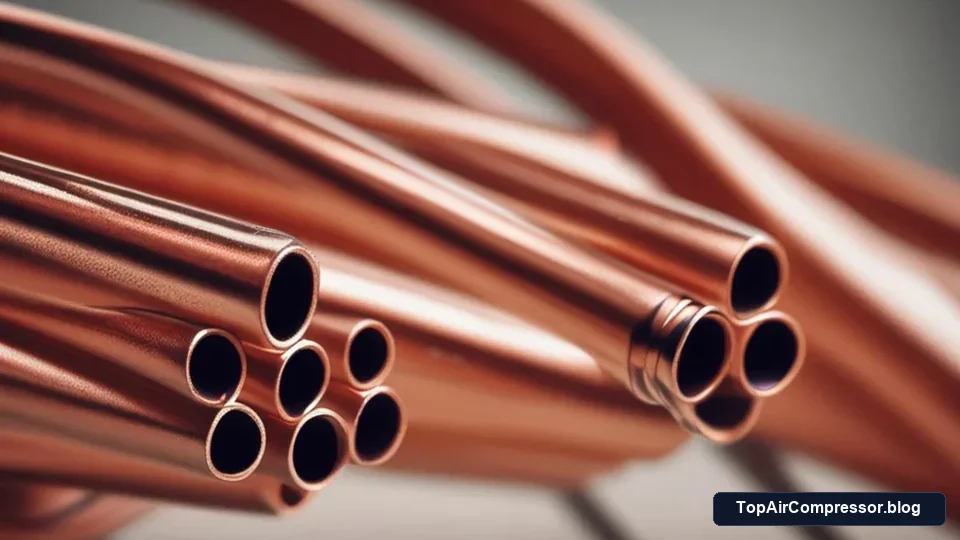
Copper piping utilizes Type L or Type K rigid copper tubing, renowned for its exceptional burst strength and rigid structural integrity. High-pressure ratings allow continuous operation.
Pex air compressor systems rely on specialized cross-linked polyethylene, engineered specifically for compressed gas applications. Selecting the best air compressor to blow out rv water lines ensures certified polymers resist fatigue fracturing.
Copper piping offers superior tensile strength under continuous high-pressure operations typical of commercial facilities. Type L hard-drawn copper safely handles operating thresholds exceeding standard workshop requirements without structural fatigue.
Cross-linked polyethylene utilizes advanced molecular bonding to deliver exceptional flexibility and burst pressure resistance. Manufacturers engineer pneumatic-grade PEX to withstand cyclical pressure spikes generated by reciprocating piston air compressors.
- Tensile strength comparisons under peak loads
- Burst pressure ratings for 3/4-inch diameters
- Compliance with OSHA and ASME standards
Cyclic Fatigue and Vibration Resistance
Reciprocating compressors generate continuous harmonic vibrations that stress rigid metallic joints over thousands of operating cycles. Flexible materials absorb these resonant shockwaves natively.
Copper networks require flexible isolation hoses near the compressor discharge to prevent stress fracture formation caused by constant mechanical oscillation and thermal cycling.
- Harmonic dampening characteristics
- Isolation hose placement guidelines
Thermal Expansion Rates and Environmental Vulnerability
Temperature fluctuations inside industrial facilities cause rigid copper pipes to expand and contract longitudinally along support brackets. Expansion loops prevent buckling along long straight runs.
Pex tubing exhibits a significantly higher coefficient of thermal expansion, requiring closer hanger spacing to prevent sagging and unsightly drooping between structural attachment points.
Rigid copper exhibits minimal thermal expansion coefficients, meaning lines remain exceptionally straight over long temperature swings. This dimensional stability prevents sagging and reduces stress on wall mounting brackets in unconditioned facilities.
Polyethylene materials feature significantly higher expansion rates requiring intentional offset loops and expansion joints. Direct ultraviolet exposure also degrades standard PEX polymers, necessitating interior routing or protective conduit shielding.
- Linear expansion coefficients for both materials
- Ultraviolet degradation risks in outdoor runs
- Chemical compatibility with synthetic compressor oils
Direct Sunlight and Chemical Exposure
Standard cross-linked polyethylene degrades rapidly when exposed to ultraviolet radiation from direct sunlight or intense shop lighting. UV-resistant coatings or indoor-only routing remain mandatory.
Synthetic ester lubricants present in modern compressor discharge air can attack unrated plastics. Reviewing the best way to run air compressor lines prevents premature swelling, softening, and catastrophic rupture under operating pressure.
- Protecting polymers from UV damage
- Lubricant compatibility standards
Installation Complexity, Fittings, and Tooling Requirements
Installing copper compressed air lines requires professional torch brazing, flux, and silver solder to achieve permanent, leak-free joints capable of withstanding heavy loads. Skilled labor is required.
Conversely, Pex air compressor networks utilize push-to-connect fittings or specialized crimp rings, enabling rapid assembly without hot work permits. Learning how to blow out sprinkler lines with air compressor ensures quick installation slashes facility downtime.
Installing rigid copper demands specialized torch brazing skills, pipe cutters, and strict adherence to fire safety protocols. Every joint must be thoroughly cleaned and fluxed to prevent catastrophic joint failure under load.
PEX systems simplify setup utilizing mechanical expansion tools and compression fittings that eliminate open flames entirely. Technicians can route lines rapidly through tight ceiling joists without specialized hot-work permits.
- Specialized crimping tools versus torch kits
- Labor hours required for a 100-foot run
- Reusability of fittings during facility expansions
Leak Mitigation and Joint Reliability
Brazed copper joints represent a permanent metallurgical bond that will never creep, separate, or loosen due to ambient temperature shifts or pressure spikes. Permanent seals eliminate mystery leaks.
Push-to-connect polymer fittings rely on internal O-rings and stainless steel grab rings, which can occasionally degrade or develop slow weeping leaks over many years of service.
- Long-term seal integrity factors
- Routine joint inspection protocols
Pressure Drop, Friction Loss, and Flow Dynamics
Smooth interior surfaces of drawn copper tubing offer minimal resistance to airflow, maintaining high volumetric efficiency across extensive distribution networks. Low friction preserves operating pressure.
Although Pex has a smooth bore, its inner diameter is often slightly smaller than equivalent nominal copper sizes when using insert fittings, which can restrict maximum flow rates.
Smooth interior walls in copper tubing promote laminar airflow and minimize internal friction loss across runs. Maintaining adequate internal diameters ensures high-demand pneumatic tools receive sufficient volumetric flow rates.
Plastic fittings in PEX assemblies can slightly restrict internal bore dimensions, potentially increasing local pressure drop metrics. Careful manifold design compensates for these localized restrictions by keeping main trunk lines oversized.
- Calculating pressure drop per 100 feet
- Impact of fitting design on effective CFM
- Maintaining optimal compressor discharge pressure
Sizing for Future Demands
Selecting the correct pipe diameter prevents excessive pressure drop that starves high-consumption tools like sandblasters and large impact wrenches of required air volume. Proper sizing future-proofs your facility.
Upgrading an existing network involves substantial labor if using rigid metals, whereas running parallel Pex secondary lines provides a scalable expansion path for growing manufacturing floors.
- Accommodating future tool additions
- Secondary header scalability
Long-Term Maintenance, Corrosion Resistance, and Leak Detection
Compressed air inherently contains moisture, which can cause internal oxidation in black iron pipe but has virtually no corrosive effect on high-purity copper networks. Corrosion immunity extends lifespan.
Pex is completely inert to moisture and compressor oils, ensuring the inner wall remains perfectly smooth and free of scaling throughout decades of continuous industrial operation. Inert polymers prevent clogging.
Copper remains completely inert against synthetic compressor oils, preventing internal chemical breakdown and corrosion resistance degradation. Regular drainage of receiver tanks protects metallic networks from accumulated condensate moisture pooling.
PEX is impervious to rust but requires strict compatibility checks against specific compressor lubricants carried downstream. Routine ultrasonic leak detection helps facility managers identify micro-fissures before major air losses occur.
- Routine ultrasonic leak detection protocols
- Inspecting structural brackets and pipe hangers
- Managing automatic condensate purge valves
Repairing Damaged Air Lines
Modifying a copper air line requires depressurizing the system, cutting the metal, and re-brazing, which introduces fire hazards and interrupts production schedules significantly. Hot work permits complicate repairs.
Repairing a punctured Pex line is remarkably straightforward, utilizing a simple pipe cutter and a mechanical coupling to restore service within a matter of minutes. Fast repairs minimize facility downtime.
- Minimizing production downtime during fixes
- Specialized repair coupling kits
Cost-Benefit Analysis across Industrial Workloads
Initial material expenses for copper tubing are notoriously high, compounded by the significant labor costs associated with professional brazing and meticulous structural mounting requirements. Upfront investment is substantial.
Pex systems offer a highly economical alternative, drastically reducing material expenses and installation hours to provide an accessible pneumatic upgrade for small-to-midsize workshops. Budget-friendly setups accelerate project completion.
Industrial workloads demand robust materials capable of withstanding heavy vibration and rigorous capital expenditure constraints. Copper delivers exceptional long-term durability despite carrying higher initial material and labor costs.
Alternatively, PEX provides significant labor savings for extensive layouts requiring rapid installation efficiency across large facilities. Evaluating total lifecycle expenses ensures optimal material selection for specific workshop environments.
- Material versus labor cost ratios
- Long-term total cost of ownership
- Resale value of metal infrastructure
Determining the Optimal System for Your Facility
Heavy automotive shops and large manufacturing plants benefit from the uncompromising durability and safety profile of a professionally installed copper distribution grid. Industrial facilities favor rigid permanence.
Mobile service trucks, woodworking shops, and DIY garages thrive on the flexibility, corrosion resistance, and fast installation made possible by specialized compressed air Pex piping. Versatile spaces optimize workflows.
- Matching material to shop environment
- Evaluating permanent versus mobile setups
Frequently Asked Questions
Can standard Pex plumbing pipe be used for compressed air lines?
Standard residential plumbing Pex completely lacks the necessary high-pressure ratings and synthetic compressor oil resistance required for safe pneumatic operation under demanding industrial workloads.
Therefore, facility managers must always utilize specialized, certified Pex tubing designed explicitly for compressed gas and high-pressure air distribution networks to ensure absolute workplace safety.
What is the maximum operating pressure for copper air lines?
Type L copper tubing easily handles hundreds of pounds per square inch of internal pressure, far exceeding typical workshop compressor outputs ranging from one hundred to one hundred seventy-five pounds per square inch.
Exceptional burst strength provides robust safety margins for permanent facility installations operating continuously under severe industrial production workloads.
Does Pex expand more than copper when pressurized?
Cross-linked polyethylene tubing experiences noticeable volumetric expansion and linear movement under shifting internal pressures and broad ambient temperature fluctuations across large production facilities.
Conversely, rigid copper maintains its exact physical dimensions without sagging, stretching, or structural shifting over extended periods of heavy industrial operation.
How do I prevent moisture damage in my distribution lines?
Facility operators should install refrigerated air dryers directly after the primary compressor tank and meticulously slope all horizontal pipe runs downward toward dedicated collection points.
Automatic condensate drains effectively eliminate trapped liquid water before it enters sensitive pneumatic tools and causes severe internal component corrosion.
Is it safe to paint or insulate copper and Pex lines?
Copper lines can be safely painted for visual system identification, while Pex must be thoroughly shielded from direct ultraviolet light exposure in bright environments.
Proper pipe insulation prevents unwanted moisture condensation buildup in humid unconditioned workshops operating throughout seasonal weather shifts.