Electric vs. Pneumatic Nailer: Which Fits Your Setup Better?
Choosing the right nailing system requires balancing the instant recovery of pneumatic air lines against the tether-free convenience of modern high-voltage electric batteries.

For high-speed production framing, the pneumatic system wins on raw cycle speed, while trim carpenters and remodelers benefit from the cordless electric nailer.
Compare all top models in our Best Air Compressor: Top Picks for Every Garage & Roadside.
Side-by-Side Breakdown
| Criteria | Electric | Pneumatic Nailer | Edge |
|---|---|---|---|
| Peak Performance & Output | Consistent up to 2-3 nails per second with modern flywheels. | Instantaneous driving force limited only by tank pressure. | Pneumatic Nailer |
| Duty Cycle & Consistency | Subject to battery drain and thermal motor cutoffs under load. | Continuous 100 percent duty cycle with a proper compressor. | Pneumatic Nailer |
| Operating Noise & Vibration | Distinct mechanical slap and high-frequency motor whine. | Loud pneumatic exhaust pop paired with compressor cycling noise. | Electric |
| Portability & Footprint | Completely self-contained with zero hoses or power cords. | Requires heavy tanks, manifold hoses, and AC/gas power. | Electric |
| Maintenance & Service Life | Complex circuit boards and gearboxes wear over time. | Simple pneumatic pistons require basic daily oiling. | Pneumatic Nailer |
| Power Requirements | Rechargeable lithium-ion battery packs and brushless motors. | Compressed air delivered via a dedicated compressor unit. | Electric |
| Best Ideal Use-Case | Punch-list repairs, mobile remodeling, and high-rise work. | High-volume production framing, decking, and roofing. | Pneumatic Nailer |
Core Architecture and Mechanical Design Differences
Pneumatic nailers utilize compressed air directed through a sliding valve to force a piston downward. This creates an instantaneous mechanical strike capable of sinking heavy framing nails effortlessly into dense lumber.
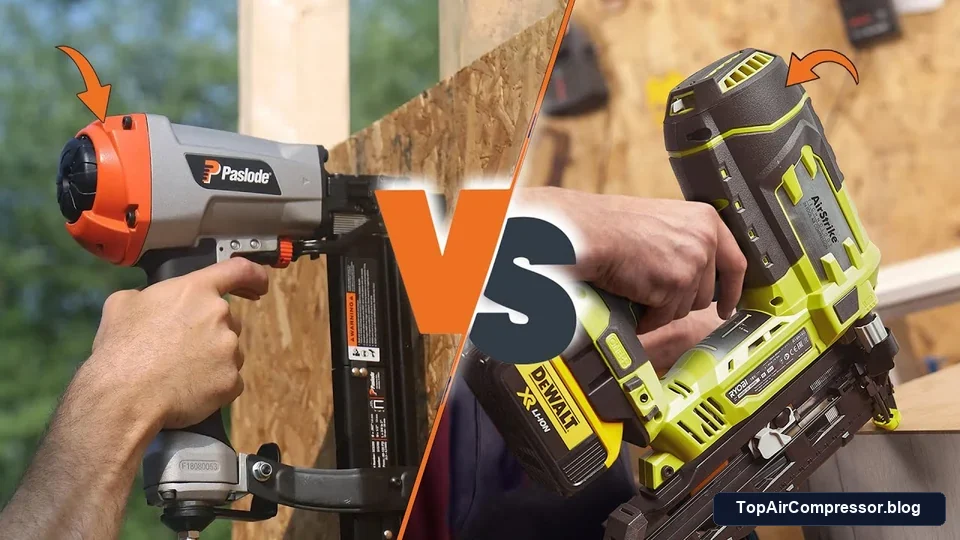
Electric nailers rely on either battery-powered solenoids, flywheels, or compressed gas cartridges. These tools convert electrical energy into rotational or linear force, storing energy in a heavy spring or flywheel moments before firing.
Pneumatic nailers utilize compressed air entering a cylinder to force a piston downward. Choosing the best pneumatic nail gun ensures you leverage simple mechanical valves for maximum cycle rates.
Conversely, cordless electric nailers incorporate heavy flywheels, linear solenoids, or compressed nitrogen cylinders. These electromechanical systems convert stored battery energy into kinetic force, adding significant bulk to the tool housing.
- Pneumatic tools feature extremely lightweight gun bodies without motors.
- Electric units integrate heavy brushless motors and control circuit boards.
- Air tools require external hoses while electric guns carry onboard packs.
Internal Energy Storage Mechanics
Pneumatic systems store potential energy inside an external air receiver tank. The nailer itself merely acts as a high-speed directional valve channeling high-pressure air into the cylinder.
Electric models compress an internal spring or spin a heavy rotor on every trigger pull. This demands significant instantaneous current draw from the lithium-ion battery pack to prevent voltage sag.
- Pneumatic pressure remains stable until tank drops below regulator setpoint.
- Electric voltage drops can slow cycle rates during intensive framing tasks.
Performance Metrics and Fastener Driving Output
Raw driving power heavily favors pneumatic systems operating at standard line pressures. Pairing your setup with the best air compressor for pneumatic tools delivers unmatched countersink depth in engineered lumber.
Modern electric nailers have closed the performance gap significantly for finish carpentry. However, rapid-fire sequence nailing can still cause flywheel spin-up delays and occasional shallow fastener seating issues.
Pneumatic tools deliver consistent driving power measured in PSI and SCFM, sustaining rapid bump-firing without motor thermal throttling. They easily sink framing nails into dense engineered lumber under continuous heavy-duty operational demands.
Electric nailers offer impressive initial speed, but sustained rapid firing can cause motor thermal overload. Recovery times depend heavily on battery discharge rates and mechanical spring or flywheel reset cycles during repetitive fastening tasks.
- Pneumatic nailers maintain consistent power across continuous high-speed firing.
- Electric nailers experience thermal throttling during extreme production sequences.
- Fastener depth adjustment mechanisms differ in mechanical responsiveness.
Handling Engineered Lumber and Hardwoods
Driving sinkers into laminated veneer lumber requires immense kinetic force. Pneumatic nailers excel here because the air volume behind the piston remains virtually unlimited during the stroke.
Electric flywheels must recover rotational velocity between consecutive shots. Driving into dense knots can occasionally stall the motor if the rebound energy overwhelms the electronic braking system.
- LVL lumber demands superior driving force from the fastener tool.
- Electric motors require smart circuit protection to prevent burnout.
Ergonomics, Weight Distribution, and Jobsite Footprint
Weight distribution represents a critical ergonomic differentiator on long overhead jobs. Pneumatic guns are exceptionally light since they lack onboard motors, but trailing rubber air hoses introduce noticeable drag.
Cordless electric nailers eliminate hose entanglement hazards completely across cluttered job sites. However, the heavy battery packs shift the center of gravity backward, increasing wrist fatigue over time.
Pneumatic nailers feature lightweight bodies because they lack onboard motors and heavy battery packs. However, trailing air hoses introduce drag and snag hazards, complicating movement across scaffolding, ladders, and tight framing corners.
Electric nailers eliminate hoses entirely, offering superior mobility for overhead tasks. However, pairing a lightweight setup with the best electric air compressor avoids battery weight fatigue during vertical trim installation.
- Pneumatic guns reduce arm strain due to minimal tool weight.
- Hose management adds friction and snag points on residential sites.
- Battery weight makes electric nailers heavier at the handle grip.
Mobility and Setup Efficiency
Moving between floors with a pneumatic setup requires dragging heavy compressors and long extension cords. Electric nailers offer immediate grab-and-go mobility for punch-list tasks and service calls.
Ladder safety improves significantly when technicians drop the cumbersome air hose. Eliminating trip hazards allows contractors to work faster in confined spaces without entangling lines.
- Compressor relocation slows down multi-story framing crews.
- Battery platforms streamline quick repair and punch-list visits.
Operational Maintenance, Durability, and Service Life
Pneumatic nailers boast legendary longevity due to their mechanical simplicity. Adding a few drops of pneumatic tool oil daily keeps internal O-rings supple and prevents premature cylinder wall scoring.
Electric nailers contain complex microchips, sensors, and brushless windings. While exceptionally durable for electronics, accidental drops can easily fracture internal housings or damage sensitive control boards.
Pneumatic systems require daily lubrication with pneumatic oil to prevent internal O-ring degradation and moisture corrosion. With proper seal replacements, these mechanical workhorses often endure decades of harsh jobsite exposure.
Electric nailers demand minimal routine lubrication but feature complex printed circuit boards and brushed or brushless motors. Electronic components are vulnerable to jobsite dust, moisture intrusion, and drop impacts that fracture internal housings.
- Air tools survive harsh jobsite conditions and moisture exposure well.
- Electric tools require clean battery contacts and firmware management.
- Routine lubrication is mandatory for long-term pneumatic reliability.
Long-Term Cost of Ownership
Maintaining a pneumatic fleet involves replacing worn bumper pads and trigger valves. These repairs are inexpensive and typically performed on-site by experienced framing carpenters within minutes.
Electric nailers face eventual obsolescence when proprietary battery platforms change. Replacing expired lithium-ion packs every few years adds a significant ongoing investment to your operational budget.
- Mechanical rebuild kits for air nailers cost very little.
- Proprietary battery replacements increase long-term expenses.
Noise Emissions, Power Sources, and Site Compliance
Jobsite noise regulations increasingly restrict loud compressor usage in residential neighborhoods. Reviewing what size compressor for pneumatic tools helps minimize jobsite disruptions while maintaining reliable operating pressure.
Electric nailers operate much more quietly during actual fastener driving cycles. The only notable sound is a brief mechanical hum as the internal motor spins up or compresses the spring.
Pneumatic setups generate high decibel levels from both the tool exhaust and the air compressor motor, often requiring hearing protection. Compressors also demand reliable generator or grid power sources on remote jobsites.
Electric nailers operate much quieter, producing only mechanical impact sounds without continuous compressor noise. This makes them ideal for indoor remodeling projects and occupied residential zones where strict noise compliance regulations apply.
- Compressors cycle loudly throughout the workday near client homes.
- Electric nailers comply easily with strict early-morning noise bylaws.
- Hearing protection remains mandatory regardless of the tool choice.
Power Independence and Infrastructure
Pneumatic setups demand reliable AC electrical service or a portable generator to run the air compressor. Voltage drops on long extension cords can easily overheat compressor motors under heavy load.
Electric nailers require zero stationary infrastructure beyond a basic battery charger. Crews can operate in remote areas without power grids simply by packing spare lithium-ion cells.
- Compressors demand high starting current from site power.
- Battery systems achieve total independence from local grids.
Weather Resilience and Extreme Temperature Behavior
Sub-zero winter job sites present severe challenges for compressed air lines. Moisture trapped in the tank or hoses can freeze instantly, causing pneumatic valves to stick and halting production completely.
Lithium-ion batteries also suffer in freezing temperatures, exhibiting reduced capacity and slower motor speeds. However, modern electric nailers handle mild moisture far better than corrosive water-laden air.
Pneumatic tools excel in extreme cold, provided dry air prevents moisture freeze-ups within valves and cylinders. Line icing remains the primary operational hazard when ambient temperatures drop significantly below freezing point thresholds.
Lithium-ion batteries in electric nailers suffer severe capacity drops in sub-zero environments. Cold temperatures also increase internal electrical resistance, slowing mechanical cycle times and reducing the total fasteners driven per charge.
- Pneumatic lines require anti-freeze pneumatic lubricants in winter.
- Cold weather diminishes lithium-ion battery discharge efficiency.
- Moisture separators protect air tools from internal water damage.
Managing Moisture and Condensation
Compressed air naturally generates heavy condensation during humid summer months. Without inline dryers and regular tank draining, water enters the nailer and washes away vital lubricating oil.
Electric nailers bypass moisture issues entirely by avoiding compressed air lines. This eliminates internal rust risks, keeping the internal driver blades clean and friction-free over extended seasons.
- Humid climates accelerate internal rust inside pneumatic cylinders.
- Electric tool housings protect internal gear trains from humidity.
Comprehensive Workload Matching and ROI Analysis
Selecting the correct nailing platform depends entirely on your daily production volume. High-output framing contractors benefit from the unmatched speed and lower consumable costs of pneumatic systems.
Remodelers, cabinet installers, and finish carpenters achieve better return on investment through electric nailers. The saved setup time and eliminated hose hassle boost daily task efficiency significantly.
High-volume production framing and pallet manufacturing favor pneumatic systems due to lower per-tool acquisition costs and infinite duty cycles. Air compressors serve multiple tools simultaneously, maximizing capital expenditure efficiency on large commercial sites.
Remodelers, punch-list contractors, and service technicians achieve better return on investment with electric nailers by eliminating hose setup times. Saving minutes on every setup outweighs the higher initial tool and battery replacement investments.
- Match the tool technology to your specific daily production volume.
- Calculate setup time and mobility requirements into your equipment budget.
- Consider existing battery ecosystem investments before purchasing.
Final Purchasing Recommendations
Invest in a pneumatic compressor kit if your business focuses on new residential construction and continuous subflooring. The durability and high cycle rates will maximize daily output.
Choose top-tier cordless electric nailers if you specialize in trim work, punch lists, or service repairs. The unrestricted maneuverability easily outweighs the higher upfront equipment cost.
- New construction favors rugged, high-speed pneumatic setups.
- Remodeling projects thrive on agile, cord-free electric tools.
Frequently Asked Questions
Can electric nailers match the speed of pneumatic nailers?
Modern electric nailers approach pneumatic speeds for short bursts, but they slow down during continuous rapid firing. For high-volume production, pneumatic systems remain faster due to unlimited air reserves.
Do pneumatic nailers require specialized daily maintenance?
Yes, pneumatic tools require regular lubrication with a few drops of tool oil before every shift. Neglecting this maintenance causes premature O-ring degradation and internal cylinder scoring.
Are cordless electric nailers heavy to use all day?
Electric nailers weigh more than pneumatic guns because they house heavy motors and battery packs. This added weight can cause noticeable wrist fatigue during overhead trim installations.
What happens to electric nailers in freezing weather?
Cold temperatures reduce lithium-ion battery capacity, leading to slower motor response times and weaker driving force. Keeping spare batteries warm in a truck cab helps mitigate winter performance loss.
Which option offers a lower total cost of ownership?
Pneumatic systems generally cost less over time because their mechanical parts are easily rebuilt. Electric nailers involve higher long-term expenses due to proprietary battery replacements.