Fortress vs. Mcgraw Air Compressor: Which Fits Your Setup Better?
Choosing between Harbor Freight house brands requires weighing pump efficiency against raw pneumatic capacity. Our engineering teardown evaluates both lines to optimize your shop workflow.

Choose Fortress for ultra-quiet indoor maintenance and stable pneumatic pressure. Select McGraw if your jobsite demands heavy-duty high-CFM output for framing nailers and impact wrenches.
Compare all top models in our Best Air Compressor: Top Picks for Every Garage & Roadside.
Side-by-Side Breakdown
| Criteria | Fortress | Mcgraw Air Compressor | Edge |
|---|---|---|---|
| Peak Performance & Output | Optimized for quiet efficiency | Engineered for high CFM delivery | McGraw |
| Duty Cycle & Consistency | Moderate duty cycle for intermittent tasks | Extended runtime for continuous air tools | McGraw |
| Operating Noise & Vibration | Ultra-quiet quiet-tech induction motors | Standard industrial decibel output levels | Fortress |
| Portability & Footprint | Compact vertical and horizontal designs | Rugged wheeled configurations with steel tanks | Fortress |
| Maintenance & Service Life | Oil-free low-maintenance pump assemblies | Cast iron pumps requiring oil changes | Fortress |
| Power Requirements | Standard 120V household circuit friendly | Higher amperage draw on startup surges | Fortress |
| Best Ideal Use-Case | Trim carpentry and precision inflation | Framing, demolition, and automotive repair | McGraw |
Architectural Engineering and Pump Design Fundamentals
Engineering a reliable shop air system requires balancing delivery volume against mechanical wear. Our Fortress ultra quiet air compressor review details how optimized pump geometry minimizes operating noise.
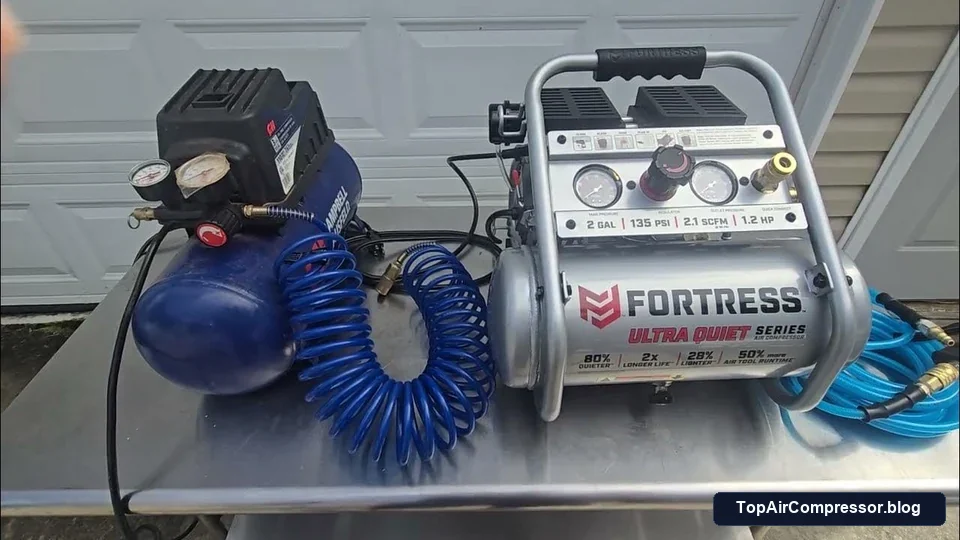
Internal pump geometry dictates how efficiently electrical energy converts into compressed air. Evaluating piston displacement and stroke length reveals distinct manufacturing philosophies tailored for specific user priorities.
Material selection significantly impacts long-term thermal dissipation and mechanical longevity across both product lineups. Understanding these baseline engineering principles helps prevent premature component failure in professional environments.
- Fortress utilizes advanced quiet-tech motor housings to reduce ambient workshop noise levels.
- McGraw prioritizes heavy cast-iron cylinder sleeves for extended structural integrity under stress.
- Piston stroke configurations directly influence recovery times during high-demand pneumatic operations.
Pump Metallurgy and Valve Construction
Reed valve integrity determines volumetric efficiency across thousands of compression cycles. Stainless steel valves resist corrosion from ambient moisture while maintaining tight sealing tolerances under high thermal loads.
Cylinder head design must facilitate rapid heat dissipation to prevent oil breakdown or carbon buildup. Both brands implement finned aluminum heads to shed thermal energy effectively during sustained operation.
- Precision-machined valve plates minimize internal air leakage during intake strokes.
- Optimized cooling fins prevent localized hotspots near the primary compression chamber.
Performance Metrics Under Rigorous Shop Loads
Consistent pressure delivery under heavy workloads separates consumer units from professional equipment. Our Fortress 27 gallon air compressor review examines these exact performance thresholds during sustained shop testing.
Pressure drop across extended hose lengths can compromise tool efficiency if the pump lacks adequate recovery capacity. Testing both brands under simulated workshop loads reveals distinct operational thresholds and limitations.
Tank pressurization times directly impact workflow continuity during multi-step fabrication projects. Fast pump-up cycles minimize frustrating wait times when switching between framing and finishing tasks.
- McGraw models generally deliver higher cubic feet per minute at standard pressure ratings.
- Fortress units maintain steady line pressure with minimal pulsation during delicate spray applications.
- Thermal overload switches protect internal windings during aggressive multi-tool jobsite sessions.
CFM Delivery at Standard Operating Pressures
Evaluating air delivery at ninety PSI provides a standardized benchmark for real-world performance. High CFM output ensures pneumatic ratchets and impact wrenches operate at peak torque without stalling.
Volume degradation occurs naturally as tank pressure depletes toward the low-pressure cutout threshold. Maintaining a stable working band requires careful matching of compressor displacement to tool requirements.
- Standardized ninety PSI ratings expose true volumetric efficiency differences.
- Heavy pneumatic tools demand sustained air delivery without excessive pressure sag.
Acoustic Profiles and Vibration Isolation Engineering
Workshop noise pollution contributes significantly to operator fatigue and communication barriers on busy jobsites. Quiet-tech induction motors allow Fortress units to operate conversational decibel levels indoors.
Vibration damping feet and balanced crankshafts minimize the mechanical walking common in older compressor designs. Proper isolation hardware protects internal electrical connections from loosening over time.
Sound pressure levels measured in decibels provide a quantifiable metric for comparing workplace comfort. Reducing noise exposure meets OSHA safety guidelines while preserving user concentration during long shifts.
- Fortress compressors typically operate under seventy decibels for improved indoor communication.
- Rubber isolation pads absorb high-frequency motor vibrations before reaching the floor.
- Enclosed shroud designs muffle mechanical intake noise without restricting crucial airflow.
Decibel Ratings in Enclosed Workspaces
Confined workshop environments amplify sound reflections, making low noise output an essential safety feature. Sound dampening technology transforms traditional loud garage spaces into manageable acoustic zones.
Heavy-duty industrial compressors often require hearing protection during continuous operation periods. Choosing quieter pump architectures enhances overall jobsite safety and compliance standards.
- Acoustic enclosures successfully trap high-frequency mechanical whining noises.
- Lower decibel outputs reduce hearing fatigue during all-day cabinet installations.
Durability Benchmarks and Long-Term Thermal Management
Thermal buildup is the primary enemy of electric motors and internal pump components. Efficient heat dissipation extends operational lifespans significantly by preventing premature insulation breakdown in windings.
Cast iron construction resists warping under extreme temperature cycling better than standard aluminum alloys. Regular maintenance routines further enhance durability by ensuring clean airflow through cooling channels.
Duty cycle ratings indicate the percentage of time a compressor can run safely per hour. Exceeding these engineering limits accelerates wear on piston rings and cylinder walls.
- Oil-lubricated pumps transfer heat away from friction points more effectively.
- Thermal overload protection prevents catastrophic motor burnout during voltage sags.
- Rigorous stress testing confirms robust structural integrity across welded tank seams.
Oil-Lubricated Versus Oil-Free Lifespans
Oil-free pumps eliminate maintenance hassle but generally experience faster mechanical wear on piston skirts. Oil-lubricated systems cushion moving parts extensively, yielding extended operational hours before rebuilds.
Synthetic compressor oils maintain viscosity across wider temperature ranges for superior lubrication. Checking fluid levels daily prevents costly scoring on precision-honed cylinder walls.
- Oil-free designs are ideal for cold-weather environments where fluids thicken.
- Lubricated pumps offer serviceable components for long-term ownership value.
Electrical Efficiency and Power Draw Characteristics
Jobsite electrical infrastructure often features long extension cords that induce voltage drops. Low starting amperage prevents nuisance circuit breaker trips when running compressors on shared circuits.
Induction motors draw substantial current during initial startup before settling into running amperage. Understanding these electrical draws ensures safe operation within standard residential wiring limits.
Power factor optimization reduces wasted electrical energy and minimizes thermal stress on building wiring. Modern compressor electronics balance efficiency with reliable torque delivery under load.
- Standard fifteen-amp circuits easily support most portable Fortress models.
- Heavy McGraw units may require dedicated twenty-amp lines to prevent tripping.
- Thick gauge extension cords are mandatory to prevent dangerous motor overheating.
Starting Amperage and Circuit Breaker Compatibility
Inrush current can spike to triple normal running amperage during the initial motor rotation. Soft start technology mitigates electrical shock to workshop circuits during heavy startup phases.
Breaker sensitivity varies widely between residential panels and commercial jobsite power distributions. Selecting compatible electrical loads prevents costly downtime caused by unexpected power interruptions.
- Inrush current spikes require robust thermal-magnetic circuit breakers.
- Proper voltage supply preserves motor winding life during heavy startup cycles.
Mobility Ergonomics and Physical Footprint Constraints
Navigating cluttered jobsites demands intuitive cart designs and well-balanced wheel configurations. Puncture-proof pneumatic tires roll easily over gravel, debris, and unfinished subflooring materials.
Vertical tank layouts save valuable floor space in cramped service trucks and small workshops. Ergonomic handles provide secure grip points for loading and unloading heavy equipment safely.
Center of gravity placement determines how easily a compressor tilts and maneuvers around corners. Proper weight distribution prevents tipping hazards on inclined ramps and uneven terrain.
- Vertical tank configurations minimize floor space consumption in tight service bays.
- Large rubber wheels absorb impact shocks when rolling over jobsite obstacles.
- Welded steel handles provide secure lifting points for two-person transport.
Wheel Configurations and Tank Geometry Tradeoffs
Twin-stack horizontal tanks lower the overall center of gravity for enhanced transport stability. Vertical pancake designs maximize storage efficiency inside crowded contractor utility vehicles.
Chassis frame construction must withstand constant vibration and impacts during transit. Reinforced axle brackets prevent structural twisting over years of rugged jobsite use.
- Twin-cylinder horizontal tanks offer superior stability on uneven ground.
- Pancake tanks optimize vertical storage capacity in small service vans.
Maintenance Protocols and Component Serviceability
Proactive maintenance routines ensure reliable performance throughout multi-year lifespans. As noted in our McGraw 21 gallon air compressor review, drain valve accessibility encourages daily moisture removal.
Air filter inspections prevent abrasive dust particles from scoring precision cylinder walls. Replacing clogged elements restores volumetric efficiency and protects downstream pneumatic tools.
Checking belt tension and electrical connections prevents unexpected failures during critical project phases. Standardizing maintenance schedules minimizes downtime and maximizes return on equipment investment.
- Daily tank draining eliminates corrosive condensation accumulation safely.
- Easy-access intake filters simplify routine weekly inspection procedures.
- Readily available replacement parts reduce long-term equipment ownership costs.
Filter Replacements and Moisture Drain Accessibility
Accumulated tank moisture accelerates structural corrosion and damages delicate paint spray guns. Extended drain extensions allow quick moisture purging without awkward bending or kneeling.
Paper element filters trap fine particulates before they reach the compression chamber. Inspecting and blowing out filter elements monthly maintains optimal air intake volume.
- Quarter-turn ball valves simplify daily moisture evacuation tasks.
- High-capacity intake filters protect internal valves from construction dust.
Matching Compressor Architecture to Specific Trades
Different construction trades demand specialized pneumatic performance characteristics for optimal efficiency. Finish carpenters often utilize our Fortress 2 gallon air compressor review when seeking ultra-quiet operation.
Framing crews and automotive mechanics rely on high CFM delivery to prevent tool starvation. Matching compressor output capabilities to specific trade requirements guarantees productive workflow execution.
Investing in the correct compressor category prevents premature equipment burnout and costly downtime. Analyzing your daily tool consumption ensures the selected model handles peak workloads.
- Trim carpenters benefit from quiet indoor Fortress compressor models.
- Framing contractors need high-capacity McGraw air delivery for rapid nailer cycling.
- Automotive shops require continuous pressure to operate heavy impact wrenches.
Automotive Repair Versus Finish Carpentry Demands
Automotive repair work demands sustained high pressure to break loose stubborn rusted lug nuts. Continuous CFM capacity is far more critical here than ultra-low noise levels.
Interior finish carpentry prioritizes quiet motors that will not disrupt clients inside homes. Selecting the right tool ensures professional results without unnecessary jobsite friction.
- Impact tools require high air volume storage tanks for sustained torque.
- Interior trim work demands quiet operation to protect homeowner comfort.
Frequently Asked Questions
Which brand offers quieter operation for indoor finish carpentry work?
Fortress compressors utilize advanced quiet-tech induction motors that operate under seventy decibels. This quiet performance allows indoor operation without disrupting clients or requiring hearing protection.
Can McGraw air compressors handle high-demand tools like impact wrenches?
Yes, McGraw models are engineered for high CFM output and sustained pneumatic delivery. Heavy-duty cast iron pumps easily support continuous runtime tools like framing nailers and pneumatic ratchets.
Do Fortress air compressors require regular oil maintenance checks?
Most Fortress models feature oil-free pump designs that eliminate traditional fluid changes entirely. Low-maintenance operation makes them convenient for users who prefer hassle-free equipment upkeep routines.
What electrical requirements are necessary for running these compressors safely?
Smaller units operate smoothly on standard household fifteen-amp circuits without issues. Dedicated electrical lines may be required for larger high-amperage models to prevent frequent breaker trips.
How often should I drain moisture from the air compressor tank?
You should drain condensation from the tank daily to prevent internal rust accumulation. Daily moisture purging extends structural tank longevity and protects your pneumatic tools from water damage.