Hot Dog Compressor vs. Pancake: Which Fits Your Setup Better?
Choosing the right portable compressed air system requires balancing tank geometry against jobsite storage needs. This guide evaluates hot dog and pancake models to optimize your pneumatic tool performance.


Hot dog compressors win for linear horizontal stability and rapid framing tasks, while pancake compressors dominate for vertical footprint savings and compact storage convenience.
Compare all top models in our Best Air Compressor: Top Picks for Every Garage & Roadside.
Side-by-Side Breakdown
| Criteria | Hot Dog Compressor | Pancake | Edge |
|---|---|---|---|
| Peak Performance & Output | Dual-tank steady airflow | Single-tank rapid recovery | Hot Dog Compressor |
| Duty Cycle & Consistency | Superior thermal dispersion | Compact moderate duty | Hot Dog Compressor |
| Operating Noise & Vibration | Lower horizontal resonance | Higher frequency whine | Hot Dog Compressor |
| Portability & Footprint | Elongated low profile | Vertical space saver | Pancake |
| Maintenance & Service Life | Easy dual-valve draining | Standard single drainage | Tie |
| Power Requirements | Standard 120V draw | Standard 120V draw | Tie |
| Best Ideal Use-Case | Framing and trim work | Finish nailing and craft | Pancake |
Fundamental Design Architecture and Tank Geometries
Evaluating compressed air architecture starts with understanding how tank geometry influences overall stability and workspace positioning. Horizontal cylinders behave differently than circular flat reservoirs during high-pressure cycles.
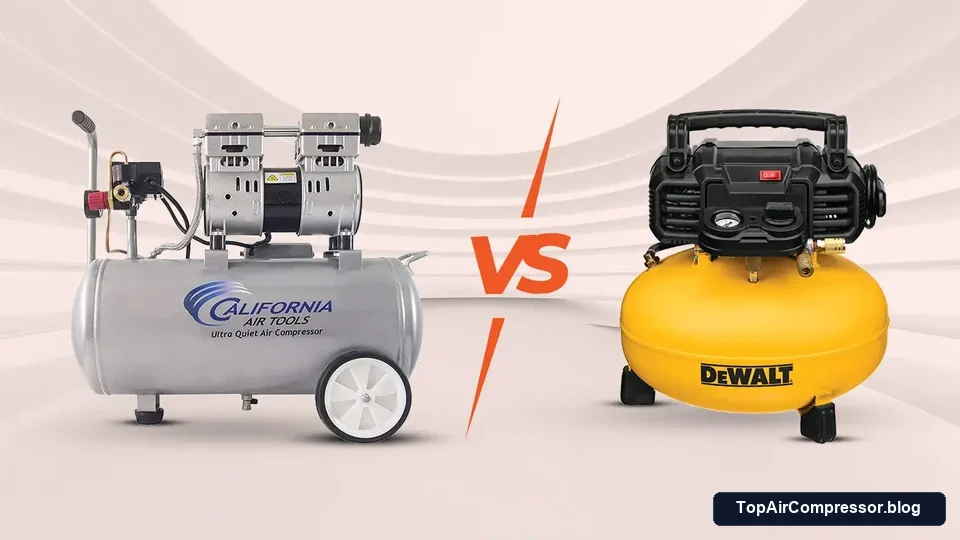
The horizontal orientation of a hot dog unit distributes weight evenly across a low center of gravity. This prevents accidental tipping on sloped roofs or uneven scaffolding planks.
Horizontal hot dog tanks feature a cylindrical single-tube layout, distributing weight evenly across a low center of gravity while optimizing floor space inside service vehicles and narrow storage shelves during transit.
Conversely, our best pancake air compressor selections utilize a flattened circular geometry that stacks air volume upward, creating a compact footprint designed specifically for tight workshop corners and vertical transport.
- Dual-tank horizontal layout lowers equipment center of mass.
- Circular pancake basin maximizes internal volume per square inch.
- Welded steel brackets secure motor assemblies to the tank spine.
Internal Volume Dynamics
Tank volume dictates how long pneumatic tools run before the motor cuts back in. Hot dog models often split capacity across dual tanks.
Pancake designs utilize a single dome-like reservoir. This engineered shape withstands high PSI ratings efficiently while maintaining a tiny footprint.
- Split reservoirs aid fast pressure recovery.
- Dome structures manage high stress efficiently.
Performance Output and Pneumatic Delivery Metrics
Delivering consistent airflow requires matching compressor displacement with the specific cubic feet per minute demands of your nailers, staplers, or blow guns.
Hot dog units typically offer slightly better recovery times due to dual-tank heat dissipation, maintaining steady 90 PSI delivery during rapid-fire framing operations.
Delivering consistent CFM at 90 PSI, our best hot dog air compressor guide helps you select models that sustain moderate pneumatic tool operations through broader usable air reserves within elongated steel tanks.
Pancake compressors prioritize rapid pressure recovery, frequently achieving 135 max PSI thresholds to handle short intermittent bursts of heavy stapling, though their smaller internal reservoir volume limits continuous high-demand air delivery.
- CFM ratings dictate continuous tool operation thresholds.
- PSI thresholds determine maximum fastener driving depth.
- Recovery speed prevents workflow bottlenecks on busy jobsites.
CFM and PSI Realities
Understanding actual volumetric output prevents premature tool starvation during heavy workloads. Always calculate tool air consumption before selecting your compressor.
Pancake variants handle standard finish nailers effortlessly, though heavy framing applications push smaller pumps past their thermal and volumetric limits.
- Match compressor CFM to tool requirements.
- Avoid running high-demand sanders on small pumps.
Footprint Optimization and Ergonomic Portability
Transporting pneumatic equipment across multi-story buildings demands careful attention to physical dimensions, weight distribution, and comfortable carrying handle designs.
Pancake units excel in tight service vans because their vertical stacking footprint consumes minimal floor space among other tools and hardware organizers.
Transporting a hot dog compressor often requires a two-handed grip due to its length, yet the elongated shape slides effortlessly beneath standard truck bed toolboxes and narrow shelving configurations without tipping over.
The circular footprint of pancake models enables convenient one-handed carry via a centralized handle, allowing technicians to navigate steep ladders and congested stairwells while keeping the equipment safely balanced against the body.
- Vertical pancake design slides easily into crowded tool bins.
- Elongated hot dog shape fits comfortably along truck bed walls.
- Balanced center handles reduce wrist fatigue during transport.
Jobsite Mobility Factors
Moving equipment up ladders or through narrow hallways tests the ergonomic viability of every portable compressor design on the market today.
Hot dog units slide smoothly over rough terrain when equipped with wheels, whereas models featured in our best pancake compressor for the money roundup require manual carrying by an integrated top handle.
- Wheeled options reduce physical lifting strain.
- Top handles offer direct vertical control.
Vibration Control and Acoustic Signatures
Operating loud mechanical pumps in residential interiors requires strict attention to decibel ratings, rubber foot isolation, and overall structural resonance.
Both styles produce noticeable noise during tank pressurization, but pancake models often exhibit slightly higher frequency whines due to compact motor housings.
Horizontal hot dog tanks distribute mechanical motor oscillations across a broader frame, minimizing localized stress concentrations and dampening overall noise emission levels during prolonged operation cycles on hard concrete floors.
Pancake designs concentrate motor weight directly above a rigid circular baseplate, occasionally increasing decibel outputs and requiring robust rubber feet to absorb high-frequency vibrations during rapid pump compression strokes.
- Rubber suction feet dampen floor vibration significantly.
- Enclosed shrouds help muffle harsh mechanical valve clicks.
- Decibel ratings guide indoor remodeling noise compliance.
Noise Mitigation Strategies
Utilizing remote air hoses paired with an entry from our best pancake air compressor for framing nailer reviews allows you to place the noisy equipment outside while working quietly in finished rooms.
Checking rubber vibration pads regularly prevents metal-on-metal rattling that amplifies ambient operating noise levels across hard jobsite flooring surfaces.
- Remote hose placement isolates pump noise.
- Isolation feet stop structural floor resonance.
Thermal Management and Duty Cycle Limits
Continuous pressurization generates intense internal heat, making efficient thermal dissipation essential for preventing premature motor burnout and seal degradation.
Hot dog twin tanks offer larger surface areas exposed to ambient air, assisting passive cooling during extended trim installation and cabinet assembly tasks.
Ambient airflow across exposed horizontal pump heads helps hot dog units dissipate heat efficiently, supporting a 50% duty cycle for routine finish carpentry tasks without triggering thermal overload protection switches prematurely.
Compact pancake housings restrict surrounding ventilation around the crankcase, necessitating engineered cooling fins to maintain safe operating temperatures during intensive fastening sequences and prevent premature internal component wear over time.
- Finned cylinder heads maximize radiant heat loss.
- Duty cycle limits prevent thermal overload protection trips.
- Forced-air fans circulate cooling air across pump windings.
Heat Dissipation Mechanics
Operating compressors in confined closets traps warm air, accelerating thermal breakdown of internal components and reducing overall motor service life.
Allowing adequate clearance around motor shrouds ensures unrestricted airflow for optimal cooling during high-demand pneumatic fastening sequences.
- Maintain clearance for proper ventilation.
- Avoid enclosing pumps in sealed cabinets.
Build Quality, Materials and Long-Term Durability
Constructing reliable pressure vessels demands certified steel thickness, robust welds, and corrosion-resistant powder coatings to withstand harsh construction environments.
Regular moisture drainage prevents internal tank oxidation, preserving structural integrity whether you choose a horizontal hot dog or vertical pancake model.
Constructed from heavy-gauge rolled steel, hot dog reservoirs resist structural twisting and external impact damage effectively, though internal condensation buildup demands regular manual draining via bottom ball valves to prevent corrosion.
Pancake tanks rely on deep-drawn welded steel bowls engineered to withstand high internal pressures safely, while protective composite shrouds shield fragile internal gauges and pressure switches from accidental jobsite drops and impacts.
- ASME certification guarantees rigorous pressure safety standards.
- Powder-coated finishes resist scratching and chemical exposure.
- Brass fittings prevent galvanic corrosion at threaded joints.
Tank Rust and Maintenance
Accumulated condensation inside compressed air reservoirs creates an ideal environment for rust formation if drain valves are neglected.
Opening bottom drain cocks after every workday expels trapped water, significantly extending the safe operating lifespan of your compressor tank.
- Drain moisture daily to prevent internal pitting.
- Inspect safety release valves periodically.
Power Draw, Electrical Demands and Circuit Safety
Running electric motors on standard 120-volt household circuits requires monitoring amperage draw to avoid tripping breakers during heavy startup cycles.
Both compressor styles typically operate on standard fifteen-amp circuits, making them versatile choices for residential remodeling and interior finish carpentry.
Drawing standard 120-volt current, hot dog compressors typically require a dedicated 15-amp circuit to prevent nuisance breaker trips caused by high starting amperage demands during initial motor startup under heavy tank pressure.
Pancake units feature efficient universal motors that manage electrical load fluctuations gracefully, but running long extension cords can cause voltage drops that threaten motor winding integrity and reduce overall operational reliability significantly.
- Starting current spikes temporarily exceed running amperage ratings.
- Dedicated circuits prevent voltage drop and motor strain.
- Thermal overload switches protect windings from low voltage.
Extension Cord Limitations
Using excessively long or thin extension cords starves the motor of necessary voltage, leading to overheating and premature electrical failure.
Selecting heavy-gauge cords ensures safe power delivery and maintains compressor performance when working far from available electrical outlets.
- Match extension wire gauge to amp draw.
- Keep cord runs short to prevent voltage sag.
Frequently Asked Questions
Can I use a hot dog compressor for framing nailers?
Hot dog compressors easily handle framing nailers because their specialized dual-tank configuration provides superior air volume and faster recovery rates for continuous fastening.
This reliable engineering advantage ensures your heavy-duty pneumatic tools never starve during rapid-fire operations on busy commercial and residential jobsites, maintaining peak operating pressure without unexpected workflow delays.
Are pancake compressors easier to store in small vehicles?
Pancake compressors excel at storage convenience because their vertical dome shape slides easily into crowded service vans among other tools, ladders, and hardware bins.
Their compact footprint maximizes available floor space in transit, making them the absolute preferred choice for mobile technicians navigating tight daily schedules across multiple urban properties.
Which style is quieter during indoor remodeling projects?
Both standard mechanical configurations produce similar decibel levels during motor pressurization, but hot dog models often feature lower-frequency resonance due to their stable horizontal positioning.
Deploying a long remote air hose helps mitigate indoor noise impacts effectively while you work inside finished residential spaces and client properties.
How often should I drain moisture from the tank?
You must drain accumulated moisture from your compressor tank after every single workday to prevent internal rust formation and dangerous structural metal degradation over time.
Opening the bottom drain valve lets trapped condensation escape completely, significantly extending the safe operating lifespan of your essential pneumatic equipment.
Can I run these compressors on a standard extension cord?
Running these portable electrical units on a standard extension cord requires a heavy-duty wire gauge to prevent harmful voltage drops that cause motor overheating and premature electrical failure.
Always avoid excessively long thin utility cords during demanding jobsite tasks to protect sensitive internal electrical components safely and maintain maximum operational efficiency.