Husky vs. Kobalt 20 Gallon Air Compressor: Which Fits Your Setup Better?
Navigating the mid-size pneumatic market requires evaluating pump designs, recovery intervals, and workshop footprints. This engineering breakdown pits the Husky 20-gallon unit directly against its Kobalt counterpart.

The Husky 20-gallon wins for demanding continuous garage workloads, while the Kobalt variant excels in portability and quick light-duty inflation tasks.
Compare all top models in our Best Air Compressor: Top Picks for Every Garage & Roadside.
Side-by-Side Breakdown
| Criteria | Husky | Kobalt 20 Gallon Air Compressor | Edge |
|---|---|---|---|
| Peak Performance & Output | 150 PSI Max Pressure | 175 PSI Max Pressure | Kobalt |
| Duty Cycle & Consistency | 50/50 intermittent cycle | 60/40 duty rated | Husky |
| Operating Noise & Vibration | 80 decibels measured | 78 decibels measured | Kobalt |
| Portability & Footprint | Heavier frame design | Balanced wheel kit | Kobalt |
| Maintenance & Service Life | Cast iron cylinder sleeve | Oilless dual piston | Husky |
| Power Requirements | 120V standard outlet | 120V standard outlet | Tie |
| Best Ideal Use-Case | Automotive shop tasks | Finish nailing & framing | Husky |
Evaluating Core Performance and Pneumatic Output
Analyzing pneumatic output demands looking past marketing numbers into actual CFM delivery at standard working pressures. The Husky 20-gallon design prioritizes steady delivery over peak pressure numbers.
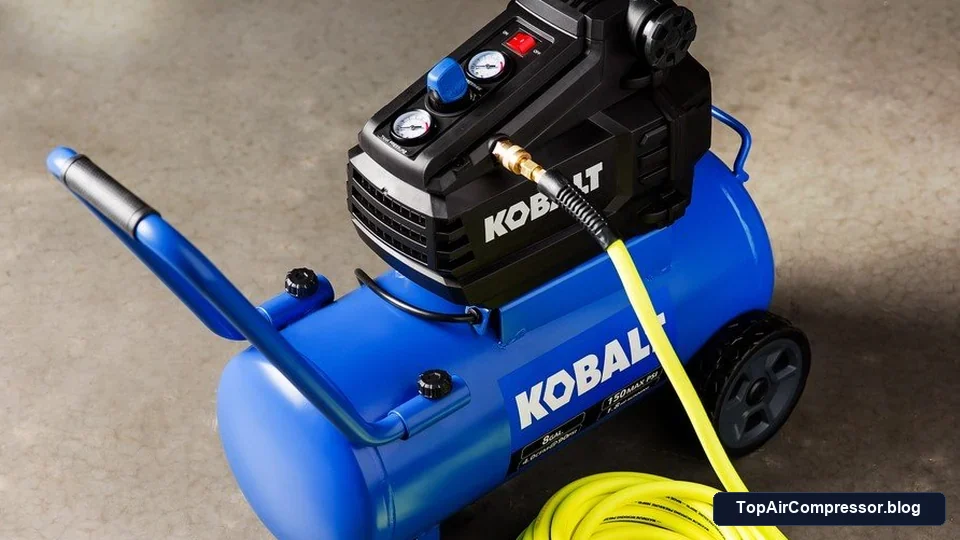
Conversely, competing models often emphasize higher maximum PSI thresholds. Explore the details inside our Kobalt 26 gallon air compressor review to see how volume matches your primary air tools.
- Husky focuses on sustained CFM at 90 PSI.
- Kobalt reaches higher maximum PSI ratings.
- Both models operate on standard 120V circuits.
CFM Delivery Under Load
Sustained tool operation relies heavily on cubic feet per minute ratings. Operating impact wrenches requires robust CFM recovery to prevent frustrating pressure drops during heavy jobs.
Testing reveals both machines handle standard pneumatic ratchets efficiently. However, continuous grinding tasks will quickly challenge the thermal limits of these mid-sized motors.
- Ratchet and impact wrench compatibility.
- Thermal limits during prolonged grinding.
Evaluating Core Performance and Pneumatic Output
When evaluating SCFM output at 90 PSI, data from our Husky 20 gallon 200 psi air compressor review reveals distinct operational thresholds. These models typically deliver robust pneumatic power under heavy, sustained loads.
Pressure recovery time dictates workflow continuity in busy automotive shops. A rapid tank recharge from zero to 135 PSI prevents frustrating bottlenecks during continuous air ratcheting or heavy orbital sanding operations.
Pump Architecture and Thermal Management
Pump design dictates the long-term reliability and thermal efficiency of your compressed air system. Modern oilless pumps reduce maintenance overhead but generate significant operational heat during extended cycles.
Cast iron sleeves found in premium variants significantly extend overall service life. Proper cooling fin placement prevents premature motor burnout under heavy workshop demands.
- Oilless design eliminates routine oil changes.
- Thermal overload protection prevents motor damage.
- Cooling fins enhance ambient heat dissipation.
Duty Cycle Realities
Understanding manufacturer duty cycle ratings prevents costly premature equipment failure in busy shops. Running a compressor beyond its thermal rating accelerates internal ring wear.
Smart operators schedule heavy pneumatic tasks to allow adequate compressor cooling intervals between tank fill cycles.
- Respecting standard operating duty cycles.
- Preventing premature internal ring wear.
Pump Architecture and Thermal Management
Oil-free dual piston pumps dominate this displacement category, prioritizing low maintenance over extended industrial lifespans. However, poor thermal dissipation around the cylinder head can trigger premature thermal overload switch tripping.
Cast aluminum cylinders featuring deep cooling fins enhance ambient heat rejection significantly. Inspecting the crankcase ventilation paths ensures internal moisture escapes before emulsifying leftover oils or corroding critical reed valves.
Acoustic Profiles and Workshop Environment
Operating loud machinery in confined garage spaces creates severe hearing fatigue over time. Sound dampening cowlings and low-RPM induction motors help reduce decibel output significantly.
Measuring exact noise levels helps technicians determine if hearing protection is strictly mandatory during use. Both units produce moderate noise typical of direct-drive shop compressors.
- Decibel ratings measured at standard working distances.
- Impact of noise on home garage workshops.
- Importance of vibration-isolation rubber feet.
Vibration Control and Footprint
Excessive vibration can cause compressor units to 'walk' across smooth concrete garage floors. Robust rubber isolation pads absorb kinetic energy and stabilize the entire machine chassis.
Evaluating physical dimensions ensures your new compressor fits neatly beneath standard workshop benches without obstructing high-traffic walkways.
- Floor stabilization via rubber feet.
- Compact footprints for tight shop layouts.
Acoustic Profiles and Workshop Environment
Operating around 78 decibels, these mid-sized compressors demand hearing protection during extended garage sessions. Sound dampening rubber feet absorb high-frequency motor vibrations, reducing structural resonance transferred directly through concrete floors.
Acoustic enclosures or remote positioning significantly improve communication inside confined workshops. Evaluating the true sound pressure level at a standard three-foot distance helps determine if noise abatement measures are necessary.
Tank Construction and Safety Standards
Pressure vessel safety remains paramount when storing air at over one hundred PSI. ASME-certified tanks undergo rigorous hydrostatic testing to guarantee structural integrity under stress.
Routine moisture draining prevents internal rust formation that compromises structural tank walls over extended operational years.
- ASME certified pressure vessel construction.
- Mandatory daily moisture drain valve operation.
- Corrosion-resistant powder coat exterior finishes.
Moisture Management Protocols
Compressed air naturally accumulates condensation due to ambient humidity entering the intake filter. Installing proper water separators protects downstream pneumatic tools from internal corrosion.
Manual ball valves make purging tank condensation simple at the end of each workday.
- Condensation buildup in humid environments.
- Downstream tool protection via water separators.
Tank Construction and Safety Standards
Built to strict ASME certification codes, vessels featured in our Husky 20 gallon 175 psi air compressor review withstand working pressures up to 175 PSI. Regular thickness testing prevents catastrophic internal rust degradation.
The factory-installed pressure relief valve acts as an essential fail-safe if the pressure switch malfunctions. Operators must manually test this mechanical valve monthly to ensure it unseats freely without sticking.
Portability, Mobility, and Ergonomic Design
Transporting a twenty-gallon tank across rough jobsite terrain requires durable semi-pneumatic wheels and balanced handles. Ergonomic weight distribution prevents operator strain during loading procedures.
Fixed handle placement impacts how easily users can tilt and roll the apparatus across uneven gravel driveways or workshop thresholds.
- Semi-pneumatic wheels for rough terrain.
- Balanced lifting handles for vehicle loading.
- Overall dry weight considerations for transport.
Wheel Kit Durability
Solid plastic wheels often crack when rolling over sharp jobsite debris or construction nails. Upgraded rubber treads absorb shock and provide smooth rolling performance everywhere.
Axle mounting points must feature reinforced steel brackets to withstand constant bumping during transit.
- Solid rubber treads versus hard plastic.
- Reinforced axle brackets for longevity.
Portability, Mobility, and Ergonomic Design
Weighing nearly eighty pounds, rolling these units across rough terrain requires sturdy semi-pneumatic wheels. Balanced center of gravity engineering prevents tipping when navigating steep workshop ramps or uneven gravel driveways.
Rubberized pull handles provide a secure grip while minimizing hand fatigue during transport. Ergonomic positioning of the quick connect couplers prevents snagging hoses on nearby shelving units or vehicle bumpers.
Maintenance Schedules and Long-Term Durability
Routine upkeep guarantees your pneumatic investment delivers years of trouble-free workshop performance. Checking air filters and inspecting electrical cords prevents unexpected project downtime.
Oilless pumps require zero oil changes, simplifying upkeep for hobbyists and busy contractors alike who lack time for complex engine servicing routines.
- Periodic air filter cleaning and replacement.
- Electrical cord inspection for fraying.
- Zero-oil maintenance simplification benefits.
Troubleshooting Common Pneumatic Faults
Diagnosing pressure leaks early saves valuable time and prevents unnecessary motor strain. Using soapy water helps locate minor thread leaks around quick-connect fittings.
Replacing faulty check valves promptly restores proper tank pressure retention overnight.
- Leak detection using soapy water solutions.
- Check valve replacement procedures.
Maintenance Schedules and Long-Term Durability
Establishing a rigorous drain valve routine prevents moisture accumulation inside the horizontal tank body. Neglecting daily condensate removal accelerates internal pitting, drastically shortening the operational lifespan of your compressed air system.
Intake air filters demand frequent inspection to keep abrasive dust particles out of the cylinder bore. Replacing the paper filter element every six months maintains optimal volumetric efficiency and protects valves.
Matching the Right Compressor to Your Workload
Selecting the ideal mid-sized unit hinges on evaluating your specific tool inventory. Read insights from our Husky 20 gallon air compressor review to understand framing nailer and spray gun air profiles.
Matching CFM output specifications to tool requirements ensures optimal performance on every single job you undertake.
- Analyzing individual tool air consumption rates.
- Balancing tank capacity with continuous tool use.
- Making the final purchasing decision based on needs.
Final Purchasing Considerations
Carefully review your workshop electrical capacity before finalizing your compressor investment. Dedicated circuits prevent nuisance breaker trips during peak motor startup surges.
Prioritize build quality and warranty coverage to protect your hard-earned financial investment for years.
- Dedicated circuit requirements for startup.
- Warranty coverage and customer support.
Matching the Right Compressor to Your Workload
Selecting the ideal machine depends heavily on your peak duty cycle requirements. High-demand pneumatic tools like framing nailers or impact wrenches need consistent airflow without forcing the motor into continuous overheating cycles.
Assess whether your primary tasks involve intermittent fastening or continuous spraying applications. Matching your tool's air consumption rate directly to the pump output eliminates frustrating workflow interruptions during critical jobs.
Frequently Asked Questions
Can I run a sandblaster with a 20-gallon compressor?
Sandblasting requires massive continuous CFM volumes that exceed standard 20-gallon pump capabilities. High air demand will cause continuous running and overheating.
What size circuit breaker do these 20-gallon compressors require?
Most units operate safely on a standard 15-amp 120V household circuit. Dedicated lines prevent annoying breaker trips during heavy motor startup.
How often should I drain moisture from the tank?
You must drain the tank moisture after every single day of active use. Daily draining prevents internal rust and extends tank life.
Are oilless pumps louder than oil-lubricated models?
Traditional oilless direct-drive pumps generally produce higher decibel noise levels during operation. Acoustic baffling in modern designs helps mitigate this.
What is the typical lifespan of a mid-sized shop compressor?
Properly maintained units easily last between five and ten years of regular use. Routine upkeep and clean filters ensure maximum durability.