Mac700 vs. Mac2400: Which Fits Your Setup Better?
Navigating the choice between these two Makita heavyweights requires analyzing pump displacement, motor load, and mobility trade-offs. We evaluate their engineering profiles to determine optimal jobsite deployment.


Choose the MAC700 for solo framing and superior portability, or select the MAC2400 for simultaneous nailing and extended duty cycles under demanding professional conditions.
Compare all top models in our Best Air Compressor: Top Picks for Every Garage & Roadside.
Side-by-Side Breakdown
| Criteria | Mac700 | Mac2400 | Edge |
|---|---|---|---|
| Peak Performance & Output | 3.3 CFM at 90 PSI | 4.2 CFM at 90 PSI | Mac2400 |
| Duty Cycle & Consistency | Moderate workload capacity | High continuous recovery | Mac2400 |
| Operating Noise & Vibration | 80 dB acoustic footprint | 79 dB low-RPM design | Mac2400 |
| Portability & Footprint | Single tank, 52 lbs | Twin cylinder, 77 lbs | Mac700 |
| Maintenance & Service Life | Cast iron pump, oil-lubricated | Heavy-duty cast iron pump | Tie |
| Power Requirements | 15-amp standard draw | 15-amp standard draw | Tie |
| Best Ideal Use-Case | Solo trim and finish | Dual-crew framing tasks | Mac2400 |
Engineering Architecture and Pump Design Fundamentals
Both compressors utilize heavy-duty cast iron pumps designed to withstand harsh jobsite environments. Their oil-lubricated designs significantly reduce internal component friction compared to standard oil-less alternatives.
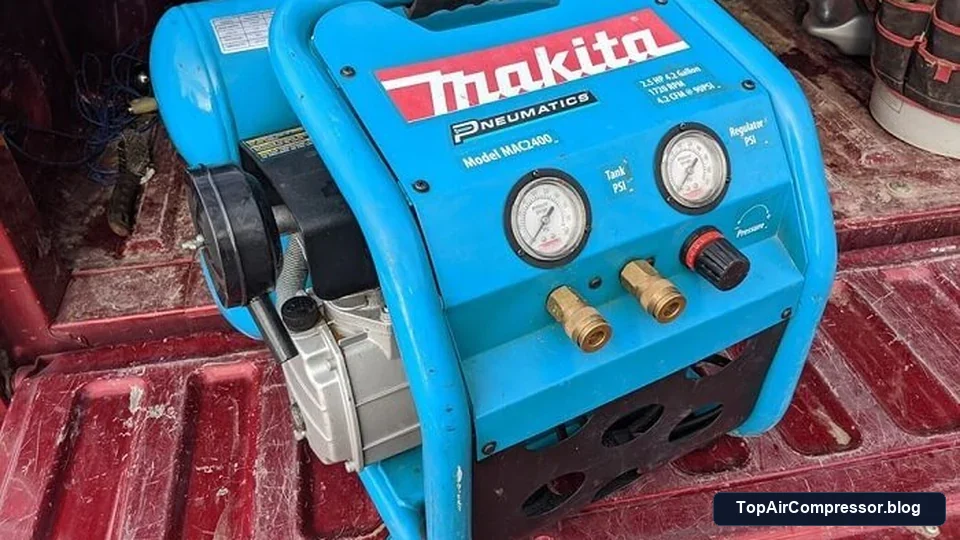
The MAC700 features a single-cylinder pump engineered for balanced stroke dynamics, whereas our Makita MAC2400 review details a robust big-bore twin-cylinder configuration built for maximum air displacement.
The Makita MAC700 utilizes a robust cast iron cylinder pump designed for maximum longevity. Its oil-lubricated design minimizes internal friction, extending component life under heavy daily jobsite conditions significantly.
Conversely, the larger MAC2400 employs a twin-cylinder cast iron pump configuration. This dual-piston layout balances mechanical loads more evenly, delivering higher displacement and smoother continuous operation for demanding pneumatic tools.
- Heavy-duty cast iron construction ensures exceptional structural longevity.
- Oil-lubricated internal mechanisms lower operating temperatures significantly.
- Precision-machined pistons maintain tight tolerances under high thermal loads.
Cylinder Configuration Differences
Single-cylinder layouts reduce overall pump complexity and maintenance points. Twin-cylinder setups distribute mechanical stress across dual pistons for superior pressure delivery.
Understanding these foundational mechanical differences helps contractors match compressor capability directly with daily pneumatic tool demands.
- Single-cylinder designs optimize weight savings and mechanical simplicity.
- Twin-cylinder configurations maximize volumetric efficiency and airflow volume.
Performance Metrics and Real-World Pneumatic Output
Pneumatic output dictates how many tools you can run simultaneously without dropping line pressure. To learn more, explore the Makita MAC700 review highlighting its respectable baseline airflow.
Stepping up to the MAC2400 provides higher CFM delivery at standard operating pressures. This extra capacity prevents rapid pressure drops when firing heavy framing nailers consecutively.
Delivering 3.3 CFM at 90 PSI, the MAC700 handles standard finish nailers and trim tools effortlessly. Its single-tank design prioritizes compact recovery times over prolonged continuous discharge capacity on commercial sites.
Stepping up to 4.8 CFM at 90 PSI, the MAC2400 drives heavy framing nailers and multiple simultaneous trim guns. The twin-tank setup buffers pressure drops effectively during high-demand fastening sequences without excessive cycling.
- MAC700 outputs 3.3 CFM at 90 PSI for standard fastening tasks.
- MAC2400 pushes 4.2 CFM at 90 PSI to support heavier pneumatic workloads.
- Higher CFM recovery minimizes tool starvation during rapid fastener sequences.
CFM Delivery Under Load
Evaluating cubic feet per minute ratings under actual jobsite pressure is vital for tool performance. Insufficient airflow causes tool lag and incomplete fastener drives.
The MAC2400 maintains steady pressure profiles during high-demand framing phases far better than smaller single-cylinder units.
- Accurate CFM metrics prevent unexpected pressure starvation.
- Consistent line pressure ensures uniform nail depth across materials.
Motor Specifications and Electrical Power Draw
Electric motors on both units are engineered to operate efficiently on standard household circuits without tripping breakers. They feature high starting torque to overcome initial tank pressure.
The robust 2.0 HP motor found on the MAC2400 works in tandem with its dual cylinders to maintain rapid recovery times during peak usage windows.
Driven by a 2.0 HP motor, the MAC700 draws minimal current during startup. This electrical efficiency prevents unwanted breaker trips when operating on long extension cords or shared residential branch circuits.
The MAC2400 integrates a heavier 2.5 HP industrial motor requiring stable 15-amp service. According to our Makita MAC2400 review, its higher torque configuration prevents thermal overload during rapid cycles.
- Both models operate safely on standard 15-amp electrical circuits.
- Low amp draw minimizes thermal overload risks on long extension cords.
- High-torque motor windings ensure reliable cold-weather startup performance.
Extension Cord Voltage Drop
Running compressors on long extension cords introduces voltage drop that strains motor windings. Using heavy-gauge copper wiring preserves motor longevity and prevents overheating.
Both Makita units handle minor voltage fluctuations gracefully thanks to their conservative thermal protection circuits.
- Always utilize 12-gauge or heavier extension cords for optimal power delivery.
- Thermal overload switches protect internal motor windings from burnout.
Acoustic Profiles and Vibration Control Engineering
Jobsite noise fatigue impacts worker productivity and safety compliance across modern commercial and residential projects. Low-RPM pump designs keep noise output remarkably manageable.
The MAC2400 operates at an impressively low 79 dB, while the MAC700 sits slightly higher at 80 dB, ensuring quiet communication.
Operating at 80 dB noise levels, the MAC700 remains relatively quiet for an oil-lubricated compressor. Thick rubber feet dampen low-frequency vibrations, protecting internal components and reducing floor-surface walking during operation.
The MAC2400 generates 79 dB noise levels, proving slightly quieter despite its larger displacement. Low pump RPM and balanced dual pistons significantly reduce harsh mechanical clatter across active interior remodeling jobsites.
- Low-RPM pump rotation drastically reduces harsh high-frequency noise emissions.
- Rubber isolation feet effectively dampen transitional mechanical vibrations.
- Acoustic ratings allow for comfortable indoor remodeling operations.
Vibration Dampening Systems
Excessive vibration can cause compressor units to walk across slick subflooring surfaces during continuous operation. Heavy-gauge steel frames and stout rubber feet lock units firmly in place.
Proper vibration isolation also protects internal electrical connections and pressure switches from premature fatigue failure.
- Sturdy frame welds withstand constant high-frequency engine impulses.
- Rubber dampeners protect delicate pressure gauges from shock damage.
Physical Footprint and Jobsite Portability Trade-offs
Portability remains a primary concern for contractors navigating multi-level residential framing jobs and frequent vehicle loading. Weight differences between these two compressors are substantial.
The lightweight MAC700 weighs 52 lbs, making it exceptionally easy for a single worker to transport across rough terrain and stairs.
Weighing 52 pounds, the MAC700 offers exceptional mobility for solo technicians climbing ladders or navigating tight stairwells. Its compact footprint fits easily beneath truck tonneau covers alongside standard toolboxes.
Tipping the scales at 77 pounds, the MAC2400 requires deliberate lifting ergonomics or a wheeled cart. The bulky twin-cylinder configuration demands dedicated vehicle storage space but provides unmatched stability on rough terrain.
- MAC700 single-tank profile fits easily inside cramped vehicle storage areas.
- MAC2400 twin-tank design distributes weight across a stable horizontal footprint.
- Carrying handles are ergonomically positioned for secure manual transport.
Loading and Transport Ergonomics
Lifting a 77-pound compressor like the MAC2400 into a truck bed requires conscious lifting posture and physical effort. Solo workers often prefer the lighter MAC700 for daily transit.
Tank orientation and center-of-gravity placement prevent tipping hazards when navigating uneven ramps or muddy jobsite pathways.
- Consider team lifting protocols for heavier twin-tank compressor models.
- Low center of gravity prevents accidental tip-overs during transit.
Thermal Management and Continuous Duty Cycles
Heat buildup is the primary enemy of pneumatic pump longevity, degrading oil viscosity and wearing piston rings. Effective cooling fins and cast iron sleeves dissipate heat rapidly.
The MAC2400 offers superior thermal recovery, handling sustained multi-tool workloads without triggering thermal shutdown sequences during heavy summer days.
Effective finned cylinder heads on the MAC700 dissipate frictional heat rapidly during intermittent cycles. Operators must respect standard 50 percent duty cycles to prevent premature breakdown of synthetic compressor lubricating oils.
The MAC2400 features heavy-duty finned copper-alloy aftercoolers that lower discharge air temperatures effectively. As detailed in our Makita Big Bore review, this advanced thermal management supports sustained 70 percent duty cycles safely.
- Cast iron cylinders retain structural integrity under extreme operating temperatures.
- External cooling fins maximize ambient air heat dissipation efficiency.
- Synthetic oil formulations prevent sludge buildup during heavy continuous use.
Preventing Pump Overheating
Operating air compressors in enclosed utility trailers during summer months drastically restricts vital cooling airflow. Providing adequate cross-ventilation prevents premature thermal overload.
Routine checks of pump oil levels ensure boundary lubrication remains intact during extended framing shifts.
- Never operate compressors inside tightly sealed storage compartments.
- Monitor oil sight glasses daily for proper fluid levels.
Long-Term Maintenance and Professional Serviceability
Routine maintenance routines directly dictate whether your air compressor lasts five years or two decades on demanding jobsites. Simple access points make servicing straightforward.
Changing pump oil, replacing intake air filters, and draining tank moisture regularly will maximize your equipment service life across all operating conditions.
Routine maintenance on the MAC700 involves simple oil level inspections through a clear sight glass. Changing the fluid annually ensures clean lubrication for the splash-fed connecting rod bearings and piston rings.
Servicing the MAC2400 requires identical sight glass monitoring alongside bi-annual air filter replacements. Accessible valve assemblies allow technicians to rebuild the cylinder head quickly without stripping the main crankcase housing.
- Inspect and clean paper intake filter elements every single week.
- Drain accumulated moisture from storage tanks daily to prevent corrosion.
- Replace pump oil annually or after heavy professional operating hours.
Moisture Management Essentials
Compressed air naturally generates condensation inside steel storage tanks as ambient humidity cools. Utilizing bottom ball valves ensures effortless daily moisture drainage.
Neglecting tank drainage leads to internal rust formation, compromising structural tank integrity and risking catastrophic failure under pressure.
- Always relieve tank pressure partially before opening drain cocks.
- Install extension drain hoses for easier access in tight setups.
Frequently Asked Questions
Can both compressors run on standard household electrical circuits?
Yes, both units feature motors optimized for standard 15-amp breakers. Ensure dedicated circuit usage to prevent nuisance tripping during heavy recovery phases.
Which compressor is better suited for roofing and framing crews?
The MAC2400 excels for framing crews due to its higher CFM output. Higher air displacement prevents pressure starvation during rapid, multi-tool nailing sequences.
How often should I change the pump oil in these Makita models?
You should change the pump oil annually or after approximately 300 hours of use. Regular oil changes preserve internal bearing surfaces and prevent premature wear.
Is the MAC700 significantly easier to transport around jobsites?
At 52 pounds, the MAC700 is considerably lighter than the 77-pound MAC2400. Solo contractors appreciate the reduced weight when navigating stairs and rough terrain.
Do these compressors require a break-in period before full use?
Yes, running the pump wide open with no tank pressure for twenty minutes helps seat rings. Proper initial break-in reduces oil consumption and improves long-term efficiency.