Makita Mac2400 vs. Mac5200: Which Fits Your Setup Better?
Evaluating the Makita MAC2400 and MAC5200 reveals a classic engineering choice. Choose between ultra-quiet low-RPM reliability and maximum tank capacity for demanding job sites.


The Makita MAC2400 wins for low-noise interior finish work and portability. Meanwhile, the MAC5200 dominates framing applications requiring extended runtimes and higher reserve capacity.
Compare all top models in our Best Air Compressor: Top Picks for Every Garage & Roadside.
Side-by-Side Breakdown
| Criteria | Makita Mac2400 | Mac5200 | Edge |
|---|---|---|---|
| Peak Performance & Output | 4.2 CFM at 90 PSI | 6.5 CFM at 90 PSI | Mac5200 |
| Duty Cycle & Consistency | Low-RPM cast iron pump | High-output big bore cylinder | Mac5200 |
| Operating Noise & Vibration | 79 decibels quiet profile | Slightly louder under heavy load | Makita Mac2400 |
| Portability & Footprint | 77 pounds twin-stack design | 88 pounds roll-cage frame | Makita Mac2400 |
| Maintenance & Service Life | Oil-lubricated long service life | Oil-lubricated high durability | Tie |
| Power Requirements | 14.5 amp motor draw | Requires stable 15-20 amp circuits | Makita Mac2400 |
| Best Ideal Use-Case | Finish carpentry and trim work | Framing and multi-user setups | Split |
Pump Engineering and Motor Specifications
The Makita MAC2400 utilizes a heavy-duty 2.5 HP cast iron pump, as detailed in our Makita MAC2400 Big Bore review, engineered to run at lower rotational speeds for extended lifespan.
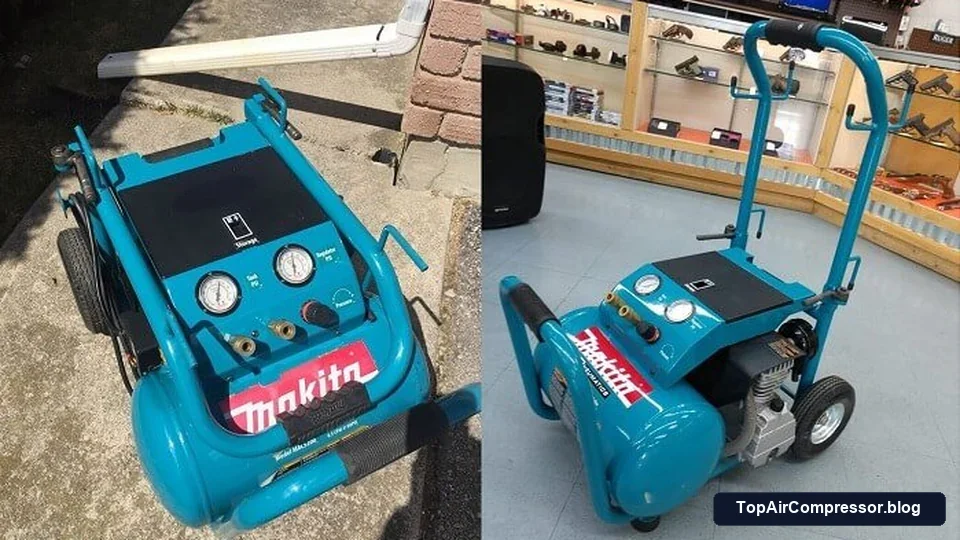
Conversely, the MAC5200 steps up to a 3.0 HP big bore cylinder designed for rapid pressure recovery. Both units feature oil-lubricated pumps that demand regular maintenance but reward users with exceptional long-term durability.
The MAC2400 features a 2.5 HP cast iron pump running at a slow 1730 RPM. This lower rotational speed significantly reduces internal operating temperatures and extends overall mechanical lifespan.
Conversely, the MAC5200 utilizes a 3.0 HP motor generating higher peak output. While it delivers increased CFM for demanding framing crews, the faster pump cycle requires vigilant thermal management during continuous operation.
- MAC2400 runs at 1,730 RPM for cooler operation.
- MAC5200 delivers 6.5 CFM at 90 PSI for heavy tools.
- Both feature cast-iron cylinders to resist wear.
Motor Amp Draw and Thermal Overload Protection
Operating heavy machinery requires careful attention to electrical loads on the job site. Both compressors include built-in thermal overload protection to prevent catastrophic motor failure during extended high-demand cycles.
Understanding these electrical thresholds keeps your investment protected against unexpected voltage spikes and power fluctuations commonly found on active commercial construction sites.
- Automatic thermal reset prevents motor burnout.
- Heavy-duty windings handle daily commercial stress.
Tank Configuration and Air Delivery Dynamics
Tank geometry plays a critical role in how these machines handle sustained pneumatic tool usage. The MAC2400 features a twin-stack 4.2-gallon tank configuration that keeps the center of gravity low and stable.
Stepping up to the MAC5200 introduces a larger single 5.2-gallon tank paired with higher CFM output. This extra capacity prevents rapid pressure drops when driving multiple framing nailers simultaneously.
A 4.2 gallon twin-tank setup on the MAC2400 provides steady pressure recovery for trim carpentry. However, high-demand tools will quickly deplete this smaller reservoir, causing the motor to cycle frequently.
Stepping up to a 5.2 gallon single tank, the MAC5200 offers a larger reserve capacity. This extra volume smooths out pressure drops during heavy stapling, preventing tool starvation on fast-paced framing jobsites.
- Twin tanks on MAC2400 balance weight efficiently.
- Single tank on MAC5200 stores more total air.
- Higher CFM ratings maintain stable working pressures.
Pressure Regulation and Gauge Accuracy
Precise air delivery relies heavily on robust industrial regulators and dual-gauge manifolds. Both models feature easily readable gauges that help operators monitor tank pressure and working pressure simultaneously without guesswork.
Quality brass fittings and heavy-duty regulators ensure leak-free performance, much like the standards highlighted in the Makita MAC5200 review, even after years of bouncing around in busy work trucks.
- Dual-gauge layout displays working and tank pressure.
- Industrial regulators resist accidental bump adjustments.
Acoustic Profiles and Noise Management
Job site noise pollution affects communication and operator fatigue over long shifts. The lower RPM motor on the MAC2400 generates just 79 dB, making it remarkably quiet for a direct-drive oil-lubricated machine.
The larger MAC5200 produces a slightly higher noise profile due to its increased horsepower and rapid recovery demands. Implementing proper placement strategies helps mitigate sound levels in enclosed residential environments.
Operating at 79 decibels, the MAC2400 prioritizes a quieter jobsite environment. The low-RPM cast iron pump design inherently dampens harsh mechanical whines, making indoor finish work much more tolerable for crews.
The MAC5200 generates roughly 90 decibels under a standard operating load. This higher noise output demands mandatory hearing protection, especially when running the unit inside enclosed residential or commercial renovation spaces.
- MAC2400 operates at a neighbor-friendly 79 decibels.
- Low-RPM pump design minimizes harsh mechanical whining.
- Ear protection remains mandatory during continuous tool operation.
Enclosed Space Considerations
Working indoors demands careful consideration of both decibel output and exhaust fumes from oil-lubricated motors. Positioning the compressor near an open doorway ensures adequate ventilation while keeping hose runs manageable.
Sound attenuation matters significantly when completing finish carpentry inside inhabited residential homes where client disturbance must be kept to an absolute minimum.
- Position units near ventilation for indoor work.
- Long hoses isolate noise away from work areas.
Jobsite Portability and Weight Distribution
Maneuvering heavy pneumatic equipment across rugged terrain requires thoughtful handling ergonomics and sturdy wheel kits. As noted in our Makita MAC2400 review, this model weighs approximately 77 pounds, making it quite manageable.
Weighing in near 88 pounds, the MAC5200 demands more physical effort during transport and setup. However, it incorporates a robust roll-cage frame that protects vital components from heavy job site impacts.
Weighing 77 pounds, the MAC2400 is manageable for solo technicians navigating staircases. Its compact twin-tank footprint balances nicely against the user's leg when carrying the equipment across uneven terrain.
The heavy-duty MAC5200 weighs approximately 88 pounds, requiring more physical effort to transport. Its extended handle and rugged wheels help offset the substantial bulk when rolling over rough subfloors or gravel.
- MAC2400 features a compact footprint for tight spaces.
- MAC5200 includes heavy-duty protective roll-cage framing.
- Integrated handles assist with loading and repositioning tasks.
Wheel Kits and Transit Stability
Transporting heavier compressors across unpaved ground tests the integrity of frames and axles. Adding an optional wheel kit transforms the MAC5200 into a rolling workstation that glides smoothly over construction debris.
Securing your equipment with heavy-duty tie-down straps prevents shifting during transit between multiple job sites throughout the busy work week.
- Optional wheels improve mobility for heavy models.
- Sturdy frames withstand rough construction transport.
Electrical Draw and Circuit Protection
Running heavy air compressors on standard residential circuits requires awareness of starting amperage spikes. As outlined in our Makita MAC2400 review, the unit draws around 14.5 amps, running safely on household breakers.
The powerful MAC5200 pushes electrical limits further, demanding stable voltage to prevent motor stalling during startup phases. Connecting this unit to dedicated 20-amp circuits ensures reliable performance during peak demand hours.
Drawing 14.1 amps, the MAC2400 pushes standard 15-amp residential circuits to their practical limits. You must avoid running other high-wattage tools on the same breaker to prevent nuisance tripping during startup.
The MAC5200 demands a 15-amp service as well, but its higher startup surge makes it sensitive to long extension cords. Using heavy-gauge wire prevents voltage drop and protects the motor windings.
- MAC2400 operates smoothly on standard 15-amp circuits.
- MAC5200 benefits from dedicated 20-amp power sources.
- Long extension cords cause voltage drop and motor damage.
Extension Cord Gauge Requirements
Voltage drop represents a silent killer of electric motors on distant job sites. Using heavy-gauge extension cords shorter than fifty feet protects compressor windings from overheating during continuous daily operation.
Choosing the right wire gauge guarantees that your motor receives full startup amperage every single time the pressure switch engages.
- Keep extension cords under fifty feet in length.
- Use heavy-gauge wiring to prevent motor overheating.
Maintenance Protocols and Wear Components
Oil-lubricated compressors demand routine inspection to guarantee long-term operational reliability. Checking the pump oil level before every shift prevents premature scoring of internal pistons and cylinder walls.
Routine tasks include draining accumulated moisture from the tanks daily to prevent internal rust formation. Changing the compressor oil annually keeps operating temperatures low and mechanical efficiency at peak levels.
Regular oil changes are vital for preserving the longevity of both pump assemblies. Check the sight glass daily and use synthetic non-detergent compressor oil to prevent premature valve carbon buildup.
Inspect the air filter elements weekly to keep abrasive dust out of the cylinder bore. Clean foam elements with mild soap, dry them thoroughly, and replace paper filters damaged by jobsite moisture.
- Check oil sight glass prior to startup.
- Drain moisture valves after every heavy workday.
- Replace air filters regularly to protect intake valves.
Valve Maintenance and Carbon Buildup
Reed valves can accumulate carbon deposits over thousands of operating cycles, reducing pumping efficiency. Inspecting and cleaning these vital components during annual tune-ups restores original factory air delivery rates.
Keeping intake filters clean prevents airborne dust from entering the cylinder head and accelerating wear on internal valve plates.
- Inspect reed valves during annual preventative maintenance.
- Clean intake filters weekly to maintain airflow.
Application Suitability and Tool Compatibility
Matching compressor output to specific pneumatic tools prevents workflow bottlenecks and frustration. The MAC2400 excels at running finish nailers, staplers, and light-duty impact wrenches for interior trim contractors.
Heavy framing crews and auto repair shops benefit immensely from the superior air delivery of the MAC5200. This machine easily handles framing nailers, ratchets, and paint spray guns without lagging.
The MAC2400 excels at running finish nailers, brad nailers, and light-duty paint sprayers. Its responsive recovery rate suits interior carpenters who value a quieter machine over maximum continuous air volume.
Choose the MAC5200 when driving heavy framing nails or operating multiple roofing guns simultaneously. The extra horsepower ensures sustained pressure for framing contractors tackling demanding, non-stop production schedules.
- MAC2400 handles finish carpentry and trim work.
- MAC5200 powers framing nailers and impact wrenches.
- High CFM output supports simultaneous multi-user setups.
Multi-User Jobsite Scenarios
Sharing a single compressed air source among multiple crew members tests pump recovery limits. The robust capacity of the MAC5200 easily accommodates two carpenters driving fasteners simultaneously without pressure crashes.
Assessing your crew size before purchasing ensures you select the correct air volume required to maintain steady productivity all day long.
- MAC5200 supports multiple framing nailers easily.
- Prevent pressure drops during high-volume production.
Frequently Asked Questions
Can I run both compressors on standard household extension cords?
Using heavy-duty 10-gauge extension cords measuring strictly under fifty feet is essential for safe operation on residential job sites. Standard thin household cords cause severe voltage drops, which can permanently damage the internal electric motor windings.
How often should I change the pump oil in these Makita models?
You should change the oil after the first fifty hours of initial break-in operation to remove metallic debris. Following that initial service, replacing the oil every hundred hours keeps the internal components running smoothly.
Which compressor is better suited for roofing contractors?
The Makita MAC5200 is significantly better suited for roofing contractors due to its larger tank and higher CFM output. This extra performance prevents pressure starvation when multiple crew members operate heavy roofing nailers continuously.
Are these compressors safe to use in cold winter weather?
Operating these oil-lubricated machines in freezing temperatures requires using synthetic compressor oil to prevent startup friction issues. Additionally, you must drain the moisture tanks frequently to prevent frozen condensation from blocking internal drain valves completely.
What is the main difference in pump design between them?
The MAC2400 utilizes a slower-revving twin-cylinder pump engineered specifically for extended pump longevity and quieter operation. Meanwhile, the MAC5200 features a high-output big bore cylinder designed to maximize recovery speed and overall CFM delivery.