Makita Mac700 vs. Mac2400: Which Fits Your Setup Better?
Choosing between these heavy-duty Makita compressors requires evaluating your job site power limits versus air volume demands. We break down the engineering specs to help contractors select the right pump.


Choose the MAC700 for solo trim carpentry and effortless transport up stairs, but select the MAC2400 when running multiple finish nailers or demanding continuous pneumatic framing tasks.
Compare all top models in our Best Air Compressor: Top Picks for Every Garage & Roadside.
Side-by-Side Breakdown
| Criteria | Makita Mac700 | Mac2400 | Edge |
|---|---|---|---|
| Peak Performance & Output | 3.3 CFM at 90 PSI | 4.8 CFM at 90 PSI | Mac2400 |
| Duty Cycle & Consistency | Intermittent trim focus | Continuous multi-tool load | Mac2400 |
| Operating Noise & Vibration | 80 dB low RPM pump | 80 dB low RPM pump | Tie |
| Portability & Footprint | 2.6-gallon twin-stack | 4.2-gallon twin-cylinder | Makita Mac700 |
| Maintenance & Service Life | Cast-iron oil lubricated | Cast-iron oil lubricated | Tie |
| Power Requirements | 12.5 Amp motor draw | 14.0 Amp motor draw | Makita Mac700 |
| Best Ideal Use-Case | Solo finish carpentry | General contracting crews | Mac2400 |
Core Motor Architecture and Pump Design Engineering
Both compressors utilize robust cast-iron cylinder pumps designed to minimize internal operating temperatures. Read our makita mac700 review to see how the MAC700 features a single-cylinder pump for enhanced thermal management.
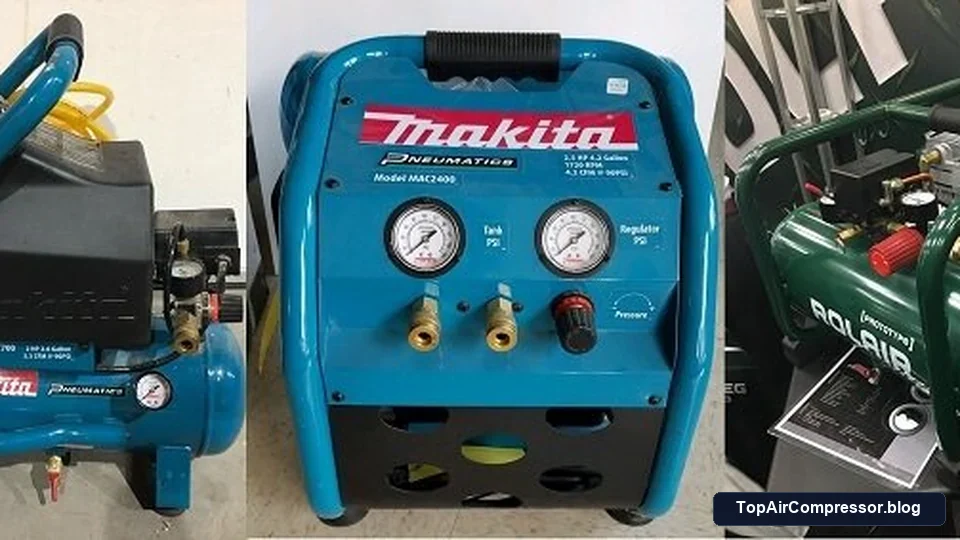
Operating at a lower 1750 RPM, these heavy-duty electric motors reduce mechanical wear significantly compared to universal motors. This slower rotational speed extends pump longevity and ensures reliable cold-weather starting on demanding sites.
- Cast-iron sleeve construction handles high compression cycles.
- Low RPM pump minimizes friction and premature valve wear.
- Heavy-duty induction motors deliver dependable torque under load.
Thermal Management Under Load
Continuous operation generates substantial heat inside the compressor pump housing. The MAC2400 twin setup dissipates thermal energy much faster than the single cylinder, preventing premature oil breakdown during framing applications.
Proper fin design on both cylinder heads channels ambient air effectively across hot zones. Contractors running continuous trim guns will appreciate the engineered thermal stability during long summer work shifts.
- Optimized fin spacing accelerates passive cooling.
- Synthetic oil compatibility protects sliding metal contacts.
Air Delivery Volume and CFM Output Benchmarks
Pneumatic performance dictates tool compatibility on busy construction sites. Read our makita mac2400 big bore review to see how the unit pushes 4.8 CFM at 90 PSI.
Higher CFM output allows the MAC2400 to support multiple finish nailers simultaneously without dropping below critical operating pressure. Solo carpenters using heavy framing nailers might still find the MAC700 adequate for intermittent firing rates.
- MAC700 handles single-tool trim and light roofing duties.
- MAC2400 powers dual nailers or continuous stapling efficiently.
- Pressure recovery times favor the higher displacement twin pump.
Pressure Recovery and Cycling Speed
Fast tank recovery prevents costly job site delays during high-volume fastening tasks. The MAC2400 refills its larger reservoir rapidly, minimizing pressure drop and maintaining consistent driving depth across dense lumber materials.
Monitoring pump cycle times reveals the structural efficiency of each unit. Operators pushing pneumatic staplers will notice fewer pressure stalls when running the high-displacement twin-cylinder Makita pump architecture.
- Rapid switch response cuts downtime between cycles.
- Maintains consistent dynamic pressure under heavy loads.
Tank Configuration and Structural Footprint Analysis
Tank geometry directly affects jobsite maneuverability and stability on uneven subfloors. The MAC700 uses a 2.6-gallon twin-stack layout, while the MAC2400 employs a 4.2-gallon twin-cylinder tank configuration for extended reserve capacity.
Compact dimensions make the MAC700 exceptionally easy to stow in crowded truck beds or carry up narrow stairwells. Conversely, the MAC2400 requires slightly more floor space but rewards the user with fewer motor restart cycles.
- Twin-stack designs lower the overall center of gravity.
- Welded steel tanks withstand harsh jobsite impact and abuse.
- Drain valves feature accessible placement for daily moisture removal.
Maneuverability and Storage Logistics
Navigating finished residential interiors demands careful equipment placement to avoid floor damage. The MAC700 lighter chassis simplifies transport, whereas the MAC2400 heavier frame demands a dedicated cart or rolling base.
Technicians should evaluate vehicle storage limitations before committing to a larger tank footprint. Both models include robust roll bars to protect critical gauges and regulators from accidental impacts.
- Ergonomic handle placement aids manual lifting.
- Protective roll cages shield vulnerable brass fittings.
Acoustic Performance and Jobsite Noise Control
Excessive noise on residential job sites creates fatigue and communication barriers among workers. Both Makita units operate at an impressively low 80 dB noise level, making them significantly quieter than standard direct-drive oil-less compressors.
Operating below standard threshold limits allows indoor contractors to run these units without violating local noise ordinances. The low RPM induction motor design is the primary reason for this reduced acoustic footprint.
- Low decibel output enables comfortable indoor renovation work.
- Cast iron dampens mechanical vibration effectively during stroke cycles.
- Rubber feet isolate unit vibration from finished hardwood floors.
Vibration Isolation and Mechanical Stability
Uncontrolled motor vibration can cause compressors to walk across smooth subfloors during operation. As noted in our makita mac2400 review, heavy-duty rubber isolation feet absorb kinetic energy, keeping the chassis firmly planted on concrete.
Balanced crankshaft engineering minimizes harmonic resonance throughout the entire operating pressure range. This engineering precision protects soldered copper lines and pressure switches from fatigue-induced cracking.
- Absorbs kinetic energy on hard concrete surfaces.
- Prevents fastener loosening on internal regulator mounts.
Electrical Draw and Circuit Protection Limits
Electrical compatibility on remote or older residential renovation sites is a critical operational factor. The MAC700 draws 12.5 amps, whereas the MAC2400 requires 14.0 amps, pushing standard 15-amp household circuits closer to their limits.
Running the MAC2400 on long extension cords requires heavy-gauge wire to prevent voltage drop and motor burnout. Electricians and carpenters must verify breaker ratings before deploying high-draw compressors on finished job sites.
- 14.0 amp draw demands dedicated 15-amp breaker capacity.
- Low-voltage startup protection prevents premature motor winding failure.
- Thermal overload switches protect against excessive operating temperatures.
Extension Cord Management and Voltage Drop
Voltage sag caused by undersized extension cords will quickly overheat electric compressor motors. Using 12-gauge or 10-gauge cords ensures the motor receives adequate amperage during heavy startup compression phases.
Proper circuit management eliminates nuisance tripping when operating heavy-duty pneumatic equipment indoors. Always plug compressors directly into wall outlets whenever possible to maintain optimal operational voltage levels.
- Minimizes electrical resistance over extended distances.
- Prevents thermal tripping during high ambient temperatures.
Maintenance Protocols and Wear Component Longevity
Oil-lubricated pumps require routine fluid checks and periodic changes to ensure maximum service life. Checking the oil sight glass daily prevents catastrophic pump failure caused by low lubrication levels during shifts.
Air filters must be inspected and cleaned regularly to prevent dust ingestion into the cylinder. Replacing worn reed valves and head gaskets during annual service keeps both compressors operating at peak volumetric efficiency.
- Change pump oil every few hundred operating hours.
- Inspect intake filters weekly in dusty construction environments.
- Drain moisture tanks daily to prevent internal corrosion damage.
Routine Service Best Practices
Establishing a strict maintenance schedule maximizes return on equipment capital investments. Keeping spare intake filters and fresh compressor oil on hand minimizes unexpected downtime on tight commercial construction schedules.
Proper winterization prevents residual condensation from cracking brass fittings during freezing weather conditions. Store units in dry, temperature-controlled environments to preserve electrical switch contacts and rubber seals.
- Keep spare maintenance parts ready in the truck.
- Store in climate-controlled spaces during freezing winters.
Application Suitability and Professional Recommendations
Selecting the right model depends entirely on your specific daily trade requirements and crew size. As detailed in our makita mac700 air compressor review, the MAC700 excels for trim carpenters requiring reliable performance.
Evaluating tool air consumption rates ensures your compressor never starves under heavy operational workloads. Investing in the correct machine prevents costly mid-project equipment upgrades and frustrating pressure delays.
- Match CFM output directly to your heaviest pneumatic tool.
- Consider weight limitations if you climb stairs frequently.
- Factor in electrical constraints of older residential remodel sites.
Final Selection Guidelines for Contractors
Professional tradespeople demand reliability, durability, and consistent pressure delivery from pneumatic equipment. Both Makita compressors deliver exceptional engineering value, provided you match their operational capabilities to your workload.
Reviewing these technical specifications empowers you to make an informed purchasing decision. Choose your compressor based on airflow demands rather than physical dimensions to ensure seamless daily jobsite performance.
- Evaluate crew size before making a final investment.
- Prioritize airflow requirements over initial equipment weight.
Frequently Asked Questions
Can I run a framing nailer continuously with the Makita MAC700?
The MAC700 handles intermittent framing nailer use adequately, but it will struggle to maintain pressure during rapid, continuous firing sequences. Consider the larger model for heavy framing tasks.
What type of compressor oil should I use in these Makita models?
Always use non-detergent SAE 30 compressor oil or synthetic equivalents specifically engineered for reciprocating pumps. Checking the oil sight glass before every shift prevents premature internal wear.
Will the MAC2400 trip a standard 15-amp household circuit breaker?
Because it draws 14.0 amps, the MAC2400 can trigger breakers if other high-draw tools operate on the same circuit. Always plug it into a dedicated 15-amp outlet.
Are these Makita compressors oil-free or oil-lubricated pumps?
Both units feature heavy-duty oil-lubricated cast-iron pumps designed for extended operational life. This traditional design runs significantly quieter and lasts much longer than oil-free alternatives.
How often should I drain moisture from the air receiver tanks?
You should drain accumulated tank moisture daily using the bottom ball valve to prevent internal rust. Doing this after every shift preserves the structural integrity of your steel tank.