Senco Pc1010 vs. Makita Mac100Q: Which Fits Your Setup Better?
We evaluate the ultra-portable Senco Pc1010 against the low-noise Makita Mac100Q to determine which lightweight pneumatic power source excels on finish carpentry jobsites.


Choose the Senco Pc1010 for maximum portability and rapid cycling during trim installation. Select the Makita Mac100Q when continuous quiet operation and lower decibel levels are paramount indoors.
Compare all top models in our Best Air Compressor: Top Picks for Every Garage & Roadside.
Side-by-Side Breakdown
| Criteria | Senco Pc1010 | Makita Mac100Q | Edge |
|---|---|---|---|
| Peak Performance & Output | Modest CFM output | Enhanced volumetric efficiency | Makita Mac100Q |
| Duty Cycle & Consistency | Intermittent trim focus | Sustained pressure delivery | Makita Mac100Q |
| Operating Noise & Vibration | Standard jobsite noise | Exceptional low decibel rating | Makita Mac100Q |
| Portability & Footprint | Ultra-lightweight roll-bar | Robust protective cage | Senco Pc1010 |
| Maintenance & Service Life | Oil-free pump design | Durable internal components | Tie |
| Power Requirements | Minimal amp draw | Standard household circuit draw | Senco Pc1010 |
| Best Ideal Use-Case | Rapid punch-list tasks | Quiet indoor remodeling | Split |
Motor Architecture and Displacement Mechanics
The Senco Pc1010 utilizes a direct-drive, oil-free pump motor designed to minimize overall weight. This configuration eliminates regular fluid checks, making it instantly ready for rapid jobsite deployment.
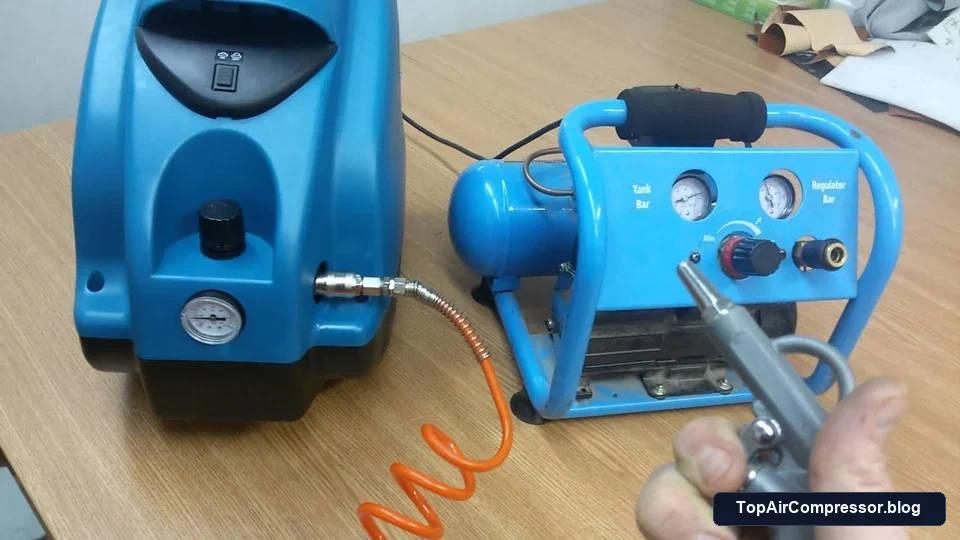
Conversely, the Makita Mac100Q incorporates a modern low-noise pump mechanism engineered to drastically reduce mechanical vibration. Its specialized dual-piston architecture achieves high efficiency without generating excessive heat.
- Direct-drive architecture eliminates belt slip issues
- Oil-free designs prevent contamination in finish work
- Low-noise pistons reduce structural resonance
Internal Pump Variations
Senco utilizes a single-cylinder pump engineered for rapid pressure recovery in light-duty applications. This setup provides adequate airflow for standard pin and brad nailers without excessive power draw.
Makita employs a dual-cylinder pump layout that balances reciprocating forces more evenly across the crankcase. Such balancing minimizes wear on internal bearings and extends the operational service life significantly.
- Single-cylinder setup prioritizes lightweight construction
- Dual-cylinder layout enhances mechanical balance
Pneumatic Delivery and Recovery Efficiency
Evaluating airflow requires analyzing cubic feet per minute ratings under specific operating pressures. Our detailed Senco PC1010 review highlights its modest output suited strictly for trim work.
The Makita Mac100Q offers improved volumetric efficiency, maintaining steady pressure during rapid fastener sequences. Technicians will notice fewer pressure drops when driving consecutive nails into dense hardwoods.
- Tank recovery times dictate workflow pacing
- Consistent pressure prevents incomplete fastener sinking
- Proper CFM matching prevents motor overheating
Tank Pressure Dynamics
Senco features a one-gallon tank that pressurizes rapidly from empty to maximum capacity within seconds. This rapid cycling is ideal for quick punch-list tasks involving small pneumatic tools.
Makita incorporates a slightly larger reservoir designed to buffer pressure drops during sustained nailing operations. This volume helps maintain steady line pressure across intermittent high-demand bursts.
- One-gallon tanks fill in seconds
- Buffered reservoirs stabilize line pressure
Acoustic Engineering and Decibel Ratings
Interior remodeling professionals working in occupied spaces must manage jobsite noise pollution carefully. You can learn more about its acoustic engineering in our Makita Mac100Q review to see decibel ratings.
The Senco Pc1010 produces standard operational noise typical of traditional compact jobsite compressors. While manageable outdoors, indoor trim crews may require hearing protection during prolonged fastener installation sessions.
- Low-noise engineering protects user hearing
- Quiet operation suits occupied residential buildings
- Sound dampening enclosures reduce high-frequency whine
Decibel Output Comparison
Makita engineered its pump assembly to run at lower RPMs without sacrificing CFM delivery. This deliberate design choice drops noise output well below traditional jobsite thresholds.
Senco maintains higher operational speeds to generate sufficient airflow from its ultra-compact motor. Consequently, the unit produces a sharper mechanical sound signature during tank replenishment cycles.
- Lower RPMs reduce overall acoustic output
- Compact motors create sharper operational sounds
Chassis Ergonomics and Transport Footprint
Portability dictates how easily a technician can navigate multi-level construction sites with tools in hand. The Senco Pc1010 features an iconic lightweight roll-bar frame that prioritizes single-handed transport.
The Makita Mac100Q adopts a more robust roll-cage configuration designed to protect vital components from severe impacts. This added structural protection marginally increases the overall carry weight.
- Roll-bar designs protect sensitive pressure gauges
- Lightweight frames reduce physical fatigue
- Compact footprints fit easily in vehicle trunks
Weight and Balance Distribution
Senco distributes weight evenly across a low-profile chassis, preventing the compressor from tipping during transit. Technicians can carry the unit comfortably alongside a standard tool belt.
Makita balances its heavier motor assembly within a centralized protective cage to maintain ergonomic carrying posture. The handle placement facilitates balanced lifting without awkward wrist strain.
- Low-profile chassis prevents tipping
- Centralized handles ease lifting strain
Duty Cycle Management and Thermal Limits
Understanding thermal thresholds prevents premature motor burnout during heavy framing applications. For heavy-duty requirements, check out our insights inside the Makita MAC5200 review detailing high-output pneumatic capacities.
The Makita Mac100Q handles sustained workloads more effectively through superior thermal dissipation fins built into the pump. These engineering features prevent excessive heat buildup during consecutive nailing sequences.
- Thermal overloads protect motor windings
- Adequate cooling extends internal seal life
- Intermittent use prevents excessive wear
Thermal Dissipation Systems
Senco relies on natural ambient airflow across its minimalist cylinder head to dissipate operating heat. Users must allow adequate ventilation clearance around the unit during operation.
Makita integrates specialized cooling channels and aluminum fin arrays that actively pull heat away from critical piston rings. This thermal management ensures reliable performance throughout long shifts.
- Ambient airflow cools minimalist heads
- Aluminum fins pull heat away rapidly
Maintenance Protocols and Component Longevity
Routine upkeep directly influences the long-term reliability of portable pneumatic compressors on busy jobsites. Both models utilize oil-free pumps, eliminating messy crankcase oil changes and fluid disposal.
Operators must still perform daily moisture drainage from the air receiver tanks to prevent internal corrosion. Regular filter inspections ensure dust accumulation does not restrict vital intake airflow.
- Oil-free pumps eliminate fluid maintenance
- Daily tank draining prevents internal rust
- Air filter cleaning maintains peak efficiency
Wear Item Replacement
Senco compressors feature accessible check valves and unloader tubes that simplify field maintenance repairs. Technicians can swap worn seals quickly without specialized workshop tooling.
Makita designs its internal manifold components for extended service intervals, reducing the frequency of required part replacements. High-grade materials resist corrosion even in humid coastal environments.
- Accessible check valves simplify repairs
- Corrosion-resistant materials improve lifespan
Electrical Draw and Circuit Protection
Operating portable compressors on shared residential electrical circuits requires careful monitoring of amp draws. The Senco Pc1010 draws minimal current, preventing nuisance breaker trips on older wiring.
The unit operates efficiently within standard household electrical parameters while delivering enhanced acoustic performance. You can read more within our complete Makita Mac100Q review highlighting voltage stability and startup draws.
- Low amp draw prevents tripped breakers
- Smooth motor starts protect sensitive electronics
- Proper extension cord gauge ensures reliability
Voltage Stability and Extension Cords
Senco operates safely on standard fifteen-amp circuits even when connected to moderate extension cord lengths. Voltage drop remains within acceptable limits for its compact motor design.
Makita requires proper cord sizing to deliver adequate starting current to its quiet motor assembly. Using heavy-gauge copper wiring ensures reliable startup during cold morning jobsite conditions.
- Fifteen-amp circuit compatibility
- Heavy-gauge wiring ensures cold starts
Frequently Asked Questions
Can both compressors run brad nailers effectively?
Yes, both units easily power standard brad and finish nailers for interior trim work, custom cabinetry installation, and detailed moulding projects across busy professional jobsites.
The Senco Pc1010 recovers pressure rapidly for light intermittent tasks, whereas the Makita Mac100Q maintains exceptionally steady airflow during rapid multi-nail sequences without experiencing significant pressure drops.
Are these compressors suitable for framing or roofing?
No, neither of these compact air compressors possesses the high cubic feet per minute displacement required for continuous framing or heavy roofing nailers on jobsites.
Professional contractors should always select larger twin-tank, wheel-barrow, or stationary units for high-volume framing applications where sustained high-pressure delivery remains absolutely critical for daily productivity.
How loud are these models during operation?
The Makita Mac100Q operates at a remarkably low decibel level specifically engineered for occupied homes and noise-sensitive residential remodeling environments without disturbance.
Conversely, the Senco Pc1010 produces a standard jobsite noise signature that remains functional outdoors but noticeably louder inside finished residential spaces during active pump tank cycling.
Do these oil-free pumps require regular maintenance?
Both models feature advanced maintenance-free oil-free pumps that completely eliminate messy fluid changes and complex crankcase oil monitoring routines for busy professional contractors.
Operators simply need to drain moisture from the steel receiver tanks daily and inspect the external intake filters regularly to ensure optimal long-term airflow efficiency and component longevity.
Which model is easier to transport across multi-level sites?
The Senco Pc1010 offers exceptional portability with its ultra-lightweight roll-bar frame designed for effortless single-handed transport across multi-level construction jobsites.
Meanwhile, the Makita Mac100Q provides superior component protection through a robust steel cage design, though it weighs slightly more overall during extended carrying distances between work vehicles.