Vertical vs. Horizontal Air Compressor: Which Fits Your Setup Better?
Choosing the right compressor geometry impacts shop footprint and vibration isolation. Evaluate vertical and horizontal receiver designs to optimize your pneumatic workflow.

Vertical compressors dominate confined shop floors with superior space conservation. Horizontal units excel in mobile configurations and lower center-of-gravity stability.
Compare all top models in our Best Air Compressor: Top Picks for Every Garage & Roadside.
Side-by-Side Breakdown
| Criteria | Vertical | Horizontal Air Compressor | Edge |
|---|---|---|---|
| Peak Performance & Output | Identical displacement per horsepower rating | Identical displacement per horsepower rating | Tie |
| Duty Cycle & Consistency | Maintains stable pressure across cycles | Maintains stable pressure across cycles | Tie |
| Operating Noise & Vibration | Higher center of gravity increases sway | Lower center of gravity absorbs vibration | Horizontal |
| Portability & Footprint | Minimal floor space consumption | Extended footprint requiring dedicated area | Vertical |
| Maintenance & Service Life | Standard vertical drain placement | Extended tank bottom surface area | Vertical |
| Power Requirements | Matches electrical motor specifications | Matches electrical motor specifications | Tie |
| Best Ideal Use-Case | Permanent stationary auto repair shops | Mobile service trucks and workshops | Split |
Engineering Fundamentals and Receiver Tank Geometry
Air compressor orientation dictates how compressed air interacts with internal tank surfaces. Selecting the right vertical receivers via our best vertical air compressor picks helps minimize direct square footage consumption in crowded professional work environments.
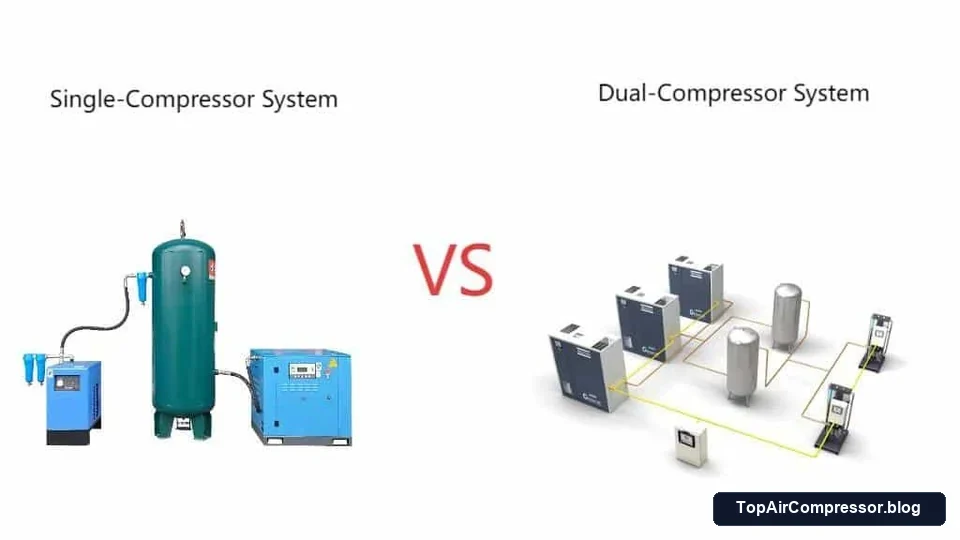
Conversely, horizontal receivers lay parallel to the floor, distributing machine weight across a broader surface area. This fundamental layout directly influences structural stress limits and overall installation requirements.
Vertical tanks utilize ASME pressure vessel codes with vertical weld seams, optimizing structural integrity for high-pressure storage. Their cylindrical shell height accommodates greater volumetric capacity without increasing the workshop footprint size.
Horizontal configurations distribute internal fluid forces across a broader horizontal footprint axis, reducing stress concentrations on the bottom saddle mounts. This geometric orientation affects how liquid condensate pools along the entire vessel length.
- Vertical models minimize floor space utilization
- Horizontal models distribute heavy pump loads
- Both designs adhere to identical ASME pressure codes
- Vertical tanks save valuable floor space while maintaining identical air storage volume compared to wide units.
- Horizontal designs lower the overall center of gravity, improving stability during heavy-duty industrial operation cycles.
Cylinder Physics and Structural Integrity
Pressure vessels must withstand immense radial and longitudinal stresses during continuous operation. ASME certification guarantees that both tank geometries meet rigorous wall thickness and safety margins.
Material fatigue manifests differently based on orientation. Vertical tanks experience uniform hoop stress, whereas horizontal tanks deal with saddle support weight distribution.
- Uniform hoop stress in vertical cylinders
- Saddle support mechanics for horizontal tanks
Footprint Optimization and Floor Space Mechanics
Floor space comes at a premium in modern commercial facilities. Reviewing portable air compressors for tools shows why vertical configurations require a remarkably small footprint, freeing up valuable square footage for other machinery.
Industrial shops often lean toward upright tanks because they tuck neatly into corners. Horizontal units demand wide clearance zones, making them less ideal for cramped service bays.
Facility floor space directly impacts operational efficiency, making vertical units the preferred choice for crowded service bays. Engineers calculate square footage utilization carefully when positioning compressors near structural walls or heavy machinery.
Horizontal compressors demand wider clearance zones, limiting installation flexibility in narrow workshops or cramped manufacturing cells. Proper aisle clearance remains vital for safe preventative maintenance access and routine daily safety inspections.
- Vertical units save valuable square footage
- Horizontal tanks require wide perimeter clearance
- Corner placement suits vertical systems best
- Vertical layout minimizes the machine footprint to maximize usable production workspace in small facilities.
- Horizontal layout requires dedicated floor perimeters, preventing obstruction of nearby walkways and exit corridors.
Maximizing Shop Layout Efficiency
Optimizing your facility layout requires careful calculation of perimeter clearance zones around heavy machinery. Vertical tanks integrate smoothly alongside tool chests and workbenches without blocking walkways.
Facility managers must balance vertical clearance limits against available floor space before final equipment placement and anchoring.
- Seamless integration near shop walls
- Clearance planning prevents workflow bottlenecks
Vibration, Stability, and Center of Gravity Dynamics
Operating heavy piston pumps generates substantial mechanical vibration that requires proper dampening. Horizontal compressors feature a naturally low center of gravity that absorbs and stabilizes operating forces effectively.
Upright machines place heavy pump motors significantly higher off the ground. Vertical models require robust floor anchoring to prevent excessive swaying during heavy load cycles.
Reciprocating pumps generate continuous mechanical vibrations that require robust anchoring to prevent structural fatigue. Vertical units possess a higher center of gravity, necessitating heavy-duty concrete floor bolting and anti-vibration isolation pads.
Horizontal receivers inherently provide superior baseline stability due to their wide stance and lower vertical profile. This design inherently minimizes harmonic resonance amplification, protecting welded tank joints from premature fatigue and stress cracking.
- Low center of gravity enhances horizontal stability
- Upright units demand secure floor bolt anchoring
- Vibration dampening pads reduce structural fatigue
- Vertical tanks demand rigid floor anchoring to counteract dynamic overturning moments during startup cycles.
- Horizontal tanks absorb operational thrust vectors more evenly across dual mounting feet welded to the shell.
Mitigating Resonance and Foundation Stress
Unchecked mechanical resonance can loosen fittings and fracture copper or steel discharge lines over time. Isolator pads placed under mounting feet absorb high-frequency harmonic vibrations efficiently.
Heavy commercial applications demand concrete pad pouring to handle the dynamic loads of large reciprocating piston pumps.
- Isolator pads prevent pipeline cracking
- Concrete foundations handle dynamic pump loads
Portability, Transport, and Mobile Jobsite Integration
Field service technicians require reliable pneumatic power sources that transition easily onto service vehicles. Horizontal twin-tank designs provide a stable platform for wheelbarrow frames and truck bed mounting.
Upright tanks have a high propensity for tipping when subjected to vehicular cornering forces. Stationary vertical units remain strictly tethered to permanent shop floors for safety.
Mobile service trucks and field contractors rely heavily on horizontal twin-tank or single-tank configurations for transit safety. A low center of gravity prevents dangerous vehicle swaying and cargo shifting during highway transit over rough roads.
Transporting tall vertical compressors on service vehicles introduces severe rollover risks unless secured with engineered tie-down braces. Contractors must evaluate vehicular weight distribution carefully to comply with department of transportation safety regulations.
- Horizontal units integrate well on service trucks
- Upright tanks present severe tipping risks in transit
- Wheelbarrow configurations suit mobile contractors
- Horizontal wheeled units offer optimal mobility for rapid deployment across changing outdoor construction jobsite environments.
- Vertical units remain stationary workshop fixtures, requiring specialized rigging equipment for safe relocation tasks.
Mobile Rig Mounting Best Practices
Securing pneumatic equipment inside a service truck bed demands heavy-duty tie-down brackets and reinforced framing. Horizontal layouts distribute weight evenly across vehicle suspension systems.
Contractors must verify that mobile generator sets match the starting amperage requirements of heavy induction motors.
- Reinforced framing secures mobile compressors
- Even weight distribution protects truck suspensions
Thermal Management and Air Delivery Efficiency
Ambient air temperature and cooling airflow directly influence overall volumetric efficiency during extended runtime intervals. Efficient pump placement ensures adequate heat dissipation across finned cast-iron cylinder heads.
Trapped heat inside poorly ventilated corners can degrade lubricating oil viscosity prematurely. Proper clearance around both orientations guarantees optimal thermal performance under heavy industrial demands.
Compressed air temperature directly affects downstream moisture accumulation and pneumatic tool performance across production lines. Vertical receiver walls encourage natural convective cooling airflow, helping dissipate compression heat before air enters distribution headers.
Horizontal tanks provide a larger surface area touching cool concrete floors, influencing bottom-shell temperature differentials. Reviewing top horizontal air compressor choices helps engineers monitor intercooler efficiency and ambient airflow to prevent thermal overloading.
- Finned cylinder heads maximize heat dissipation
- Adequate airflow protects lubricating oil viscosity
- High temperatures reduce volumetric efficiency
- Effective thermal dissipation reduces moisture vapor concentration inside the primary compressed air receiver tank.
- Poor ventilation around tightly installed tanks accelerates internal moisture condensation and downstream airline corrosion.
Condensation Physics and Moisture Separation
Compressed air inherently carries moisture that condenses inside the receiver tank during cooling cycles. Automatic tank drains purge accumulated water efficiently regardless of tank orientation.
Horizontal tanks feature elongated bottom surfaces where moisture can pool over extended periods if drainage protocols are ignored.
- Automatic drains remove harmful moisture
- Elongated tanks require vigilant bottom inspections
Maintenance Protocols and Condensate Management
Routine maintenance keeps pneumatic systems operating safely throughout their designated structural design lifespan. Daily condensate drainage prevents accelerated internal rust formation on tank walls.
Accessing bottom drain valves on upright units is straightforward with extended drain line kits. Horizontal tanks require clear crawl space underneath for safe valve manipulation.
Water vapor constantly condenses inside pressure vessels, requiring diligent draining routines to prevent internal rust perforation. Vertical tanks pool moisture at the bottom dome, making automatic drain valve installation essential for daily maintenance routines.
Horizontal vessels accumulate condensate along their entire bottom longitudinal seam, creating unique corrosion vectors over time. Technicians must inspect tank wall thickness periodically using ultrasonic gauges to ensure safe operating pressure limits.
- Daily draining prevents internal rust damage
- Extended drain lines improve service accessibility
- Bottom valve placement requires adequate clearance
- Daily manual or automated purging prevents dangerous corrosion accumulation at the lowest vessel points.
- Horizontal tanks require slight tilting or proper leveling to ensure complete drainage of trapped liquid moisture.
Inspection Schedules and Safety Compliance
Scheduled safety inspections protect operators from catastrophic pressure vessel failure in commercial environments. Visual checks should encompass pressure relief valves, gauges, and mounting bolts.
Facility managers must document all routine maintenance logs to comply with local occupational safety and health regulations.
- Visual checks verify relief valve operation
- Maintenance logs ensure regulatory compliance
Selecting the Optimal Unit for Your Industrial Workload
Choosing between upright and horizontal compressor configurations depends heavily on your operational constraints. Consulting our portable tire air compressor guide helps managers address space limitations favoring tall vertical receivers in busy shops.
Mobile contractors and service fleets should prioritize stable horizontal tanks for safe transport. Evaluating your workload ensures maximum productivity and long-term equipment reliability.
Choosing between vertical and horizontal configurations depends on facility layout, mobility needs, and duty cycle requirements. Plant managers analyze peak CFM demand and available floor dimensions before purchasing heavy industrial compressor systems.
Balancing spatial constraints with mechanical stability ensures long-term equipment reliability and lowers total cost of ownership. Consulting detailed engineering specification sheets helps match compressor output directly to facility pneumatic demands.
- Space constraints dictate vertical selection
- Mobile operations require horizontal stability
- Workload analysis drives smart purchasing decisions
- Select vertical compressors when workshop floor space is severely limited and permanent installation is feasible.
- Choose horizontal models for mobile service trucks or facilities prioritizing low vibration and easy maintenance.
Final Decision Matrix for Facility Managers
Weighing all engineering factors helps facility managers invest in reliable pneumatic infrastructure. Comprehensive site assessments eliminate costly retrofits and installation errors down the road.
Consulting professional mechanical engineers ensures your electrical supply matches compressor motor specifications.
- Site assessments prevent costly installation mistakes
- Electrical compatibility guarantees seamless startup
Frequently Asked Questions
Do vertical air compressors produce less overall output power compared to horizontal units?
Vertical and horizontal air compressors with identical pump displacements deliver the exact same pneumatic output power. Tank orientation only changes the physical footprint and center of gravity rather than volumetric efficiency.
Why do mobile service trucks exclusively use horizontal air compressor configurations?
Horizontal compressors feature a low center of gravity that resists tipping forces during vehicular transport. Vehicle stability remains paramount when driving over uneven terrain or navigating tight highway corners.
How does moisture accumulation differ between vertical and horizontal receiver tanks?
Both tank styles collect identical amounts of condensation from compressed air cooling cycles over time. Elongated horizontal tanks distribute moisture across a wider bottom surface requiring diligent drainage.
Are vertical air compressors more difficult to anchor securely to shop floors?
Upright compressors possess a higher center of gravity requiring robust concrete anchoring to prevent swaying. Proper anchor bolting ensures the taller structure remains stable during heavy reciprocating pump cycles.
Can I convert a horizontal air compressor into a vertical setup to save space?
Converting tank orientations is extremely dangerous and strictly violates ASME pressure vessel certifications. Pump mounting brackets and safety valves are specifically engineered for one designated operational position only.