Viair 85P vs. 88P: Which Fits Your Setup Better?
Choosing a portable 12-volt compressor requires balancing electrical draw with tire inflation speed. This direct engineering comparison evaluates the Viair 85P and 88P to determine your ideal roadside emergency tool.


The Viair 88P wins for faster inflation speeds and direct-battery clamps. Choose the Viair 85P if you strictly need a basic cigarette lighter connection for smaller passenger car tires.
Compare all top models in our Best Air Compressor: Top Picks for Every Garage & Roadside.
Side-by-Side Breakdown
| Criteria | Viair 85P | 88P | Edge |
|---|---|---|---|
| Peak Performance & Output | 1.90 CFM at 0 PSI | 1.47 CFM at 0 PSI | Viair 85P |
| Duty Cycle & Consistency | 20 percent at 30 PSI | 25 percent at 100 PSI | 88P |
| Operating Noise & Vibration | Moderate acoustic output | Standard mechanical hum | Tie |
| Portability & Footprint | Ultra compact design | Slightly larger chassis | Viair 85P |
| Maintenance & Service Life | Low maintenance needs | Sealed long-life motor | 88P |
| Power Requirements | 12V accessory socket | Direct battery clamps | 88P |
| Best Ideal Use-Case | Standard sedan tires | Truck and SUV tires | 88P |
Engineering Architecture and Power Delivery Fundamentals
Portable twelve-volt compressors rely on efficient fractional horsepower motors. You can learn more about its electrical demands by checking our detailed Viair 88P portable air compressor review today.
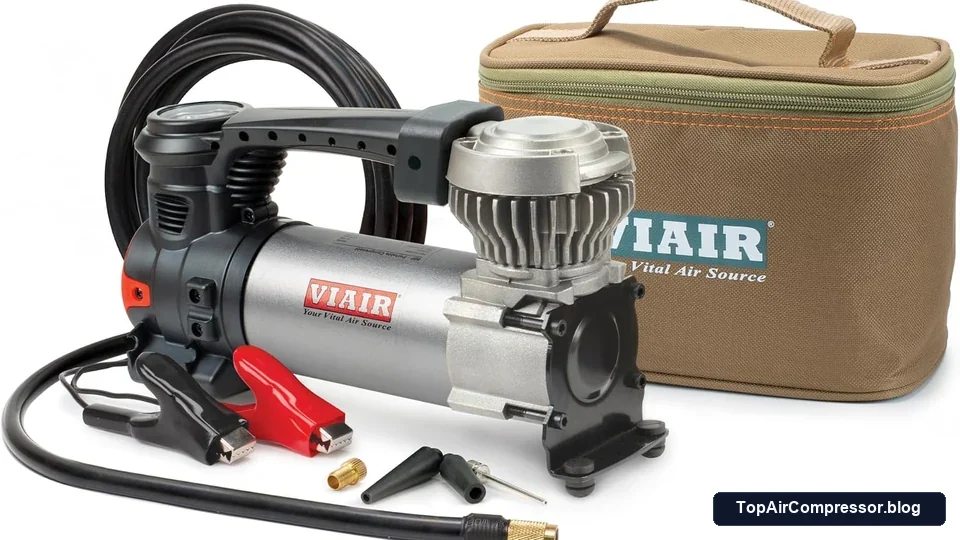
Understanding these foundational power architectures helps prevent blown fuses and vehicle electrical strain. Both units employ oil-less permanent magnetic motors designed to operate reliably across varied ambient weather conditions.
The VIAIR 85P relies on a lighter permanent magnet motor drawing power directly through a standard auxiliary socket. This architecture limits continuous current draw safely below 10 amps to protect vehicle wiring.
Conversely, the VIAIR 88P utilizes heavy-duty battery clamps that interface directly with the 12-volt battery posts. This robust connection safely handles a 20-amp max draw, delivering superior electrical efficiency and sustained motor torque.
- Direct battery routing prevents internal vehicle fuse failures.
- Accessory socket limits restrict maximum safe current draw.
- Permanent magnetic motors offer dependable cold-weather starting torque.
Electrical Circuit Protection and Amperage Limits
The 85P restricts its maximum current draw to match standard dashboard accessory socket ratings. Operating heavy loads through factory wiring harnesses always carries inherent thermal risks if limits are ignored.
Direct battery clips on the 88P bypass factory fuses entirely. This delivers cleaner voltage supply directly to the compressor winding for maximum sustained performance.
- Accessory fuses typically cap out at fifteen amps.
- Direct clips handle transient current spikes safely.
Maximum Operating Pressure and Air Delivery Dynamics
Air delivery volume dictates how rapidly you can inflate a completely flat tire. Many models featured in our best Viair compressor guide push higher volumetric flow at zero pressure for rapid filling.
Conversely, the 88P maintains sustained pressure capabilities deeper into the high-pressure zone. This makes it vastly superior for light truck applications requiring high working pressures.
Operating pressures dictate inflation speeds for larger off-road tires and commercial setups. The 85P peaks at 60 PSI, making it well-suited for standard passenger vehicles, compact trailers, and recreational inflatables requiring moderate pressure thresholds.
Stepping up to the 88P unlocks a 120 PSI maximum rating, doubling the pressure ceiling. This enhanced capacity lets technicians seat stubborn tire beads and inflate heavy-duty truck tires without stalling the internal piston.
- Volumetric efficiency drops as tire pressure steadily increases.
- High pressure ratings prevent motor stalls near peak loads.
- Air delivery rates dictate total roadside waiting times.
Volumetric Efficiency Curves Under Load
Piston displacement determines the fundamental pumping capacity of these compact portable units. Evaluating real-world CFM delivery reveals how well each pump handles large-volume off-road tires.
As backpressure builds inside the tire cavity, motor RPM naturally decreases slightly. Well-matched cylinder heads minimize thermal throttling during these demanding operating cycles.
- Piston displacement dictates true CFM output metrics.
- Thermal throttling affects sustained high-pressure delivery.
Duty Cycle Limits and Thermal Management Protocols
Thermal management dictates portable compressor longevity. As detailed in our comprehensive Viair 88P review, this unit features a robust 25 percent duty cycle at one hundred pounds per square inch.
The smaller 85P model operates on a shorter twenty percent duty cycle limited to lower pressures. Exceeding these engineering thresholds risks permanent thermal damage to internal components.
Thermal management remains critical when running small oil-less compressors under heavy field workloads. The 85P features a 25 percent duty cycle, requiring mandatory cooling intervals after ten minutes of continuous runtime at standard ambient temperatures.
Extending operations to the 88P provides a 35 percent duty cycle, allowing for fifteen minutes of continuous pumping at 30 PSI. Integrated cooling fins dissipate cylinder heat rapidly, preventing permanent thermal degradation of internal seals.
- Duty cycles dictate mandatory cool-down periods between tires.
- Internal thermal overload switches prevent catastrophic motor burnouts.
- Ambient air temperature directly influences total operating duration.
Heat Dissipation and Cylinder Head Design
Finned aluminum cylinder heads actively shed excess heat during prolonged inflation sessions. Good thermal transfer protects internal piston rings from premature thermal degradation and wear.
Operators should always monitor exterior housing temperatures during multi-tire inflation tasks. Allowing adequate resting intervals preserves the overall lifespan of the miniature electric motor.
- Aluminum fins maximize convective cooling efficiency.
- Piston ring integrity depends on stable operating temperatures.
Physical Footprint, Build Quality, and Portability Metrics
Storage space inside a passenger vehicle is often critically limited. The Viair 85P boasts an ultra-compact footprint that easily stows beneath most standard passenger car seats.
The 88P requires slightly more storage room due to its heavier baseplate and battery clamps. However, its rugged structural chassis offers superior impact resistance during field service.
Unit dimensions dictate how easily equipment stows inside crowded emergency kits or specialized vehicle compartments. The compact 85P measures under four pounds, prioritizing effortless stowing inside glove boxes or small under-seat storage bins.
Weighing nearly six pounds, the 88P trades minor weight savings for a sturdy steel chassis and vibration-isolation feet. This robust construction absorbs severe shock and prevents shifting during aggressive off-road travel or commercial transit.
- Compact housings fit neatly inside crowded vehicle trunks.
- Heavy baseplates prevent unwanted vibration-induced wandering.
- Durable exterior coatings protect against outdoor corrosion.
Chassis Construction and Vibration Isolation
Solid metal baseplates keep the compressor stable while running on rough terrain. Integrated rubber feet absorb high-frequency vibrations before they transfer into the ground.
Poorly isolated pumps tend to crawl across asphalt during extended inflation cycles. Both Viair units feature effective dampening feet to maintain stable placement.
- Rubber feet minimize unwanted mechanical walking.
- Rigid metal frames protect vulnerable internal pneumatic lines.
Acoustic Profiles, Vibration Damping, and Ergonomics
Operating noise is an unavoidable characteristic of piston-driven air compressors. The Viair 85P produces a manageable mechanical hum typical of small motorized garage tools.
The larger 88P generates slightly higher decibel levels due to its increased motor output. Effective ergonomic handles make transporting both units to distant wheel valves straightforward.
Noise mitigation directly impacts user comfort when operating portable compressors in close proximity to residential areas or campsites. The 85P generates a moderate acoustic footprint, producing roughly 70 decibels during standard inflation tasks.
Operating the heavier 88P introduces slightly higher mechanical resonance, mitigated effectively by rubber base pads. These isolators absorb high-frequency chatter, reducing ground-transmitted vibration and keeping the compressor stable on uneven gravel or dirt surfaces.
- Decibel ratings remain within safe occupational hearing limits.
- Ergonomic handle placement improves overall transport safety.
- Balanced internal masses reduce aggressive harmonic shaking.
User Interface and Pressure Gauge Readability
An integrated analog pressure gauge allows for real-time monitoring during inflation. Clear dial markings ensure operators can accurately hit target tire pressures without guesswork.
Bleed valves integrated into the hose assembly allow precise pressure adjustments. This prevents over-inflation and eliminates multiple attachment cycles during field use.
- Analog dials provide dependable mechanical pressure feedback.
- Integrated bleed valves simplify final pressure tuning.
Maintenance Schedules and Field Reliability Factors
Oil-less engineering designs significantly reduce routine mechanical maintenance requirements. As noted in our Viair 88P field testing review, the sealed piston needs virtually no internal lubrication.
Keeping exterior intake filters clean remains the primary user maintenance task. Periodic inspection of electrical wiring ensures safe and reliable operation during emergencies.
Routine maintenance routines for oil-less miniature compressors focus primarily on keeping intake filters clean and checking air hoses. Inspecting the inline air filter element monthly prevents abrasive dust from scoring internal cylinder walls.
Field reliability drops significantly if moisture accumulates inside the braided leader hose during humid operational cycles. Periodically purging condensed water and checking electrical alligator clips ensures reliable starts during critical roadside tire emergencies.
- Oil-less designs eliminate messy internal fluid changes.
- Intake air filters protect internal cylinders from dust.
- Periodic wire inspections prevent unexpected roadside electrical failures.
Long-Term Durability and Component Wear
Quality internal components dictate how many years a portable compressor will survive. Stainless steel valves and durable connecting rods ensure dependable service across seasons.
Protecting the unit from moisture and road salt extends its operational life significantly. Storing the compressor in a dry compartment prevents premature corrosion on electrical contacts.
- Stainless steel valves resist rust and fatigue.
- Moisture protection safeguards electrical terminal integrity.
Workload Matching: Which Unit Fits Your Fleet
Selecting the right compressor ultimately depends on your specific vehicle tires. Passenger cars with low-volume tires match perfectly with the lightweight Viair 85P system.
Light trucks, Jeeps, and full-size SUVs demand the elevated pressure and direct battery power of the 88P. Matching equipment specifications prevents frustrating roadside performance bottlenecks.
Choosing the correct portable unit depends heavily on your vehicle type, tire volume, and frequency of use. Fleet operators managing light commuter pools find the 85P ideal for routine top-ups without draining vehicle power.
Conversely, agricultural teams and overlanding enthusiasts should deploy the 88P to handle oversized off-road tires reliably. Matching equipment capabilities to actual air demand prevents premature burnout and guarantees dependable emergency inflation performance.
- Sedans and hatchbacks favor the lighter 85P model.
- Trucks and off-road vehicles require the powerful 88P.
- Proper workload matching ensures reliable emergency preparedness.
Emergency Readiness Versus Recreational Off-Roading
Occasional flat tire recovery demands a simple and fast setup process. The 85P provides quick convenience for standard commuters who rarely venture off paved roads.
Off-road enthusiasts airing down tires frequently need the endurance of the 88P. Its higher thermal threshold handles repeated inflation cycles without overheating prematurely.
- Commuters benefit from simple accessory socket plugs.
- Off-roaders require high endurance and thermal resilience.
Frequently Asked Questions
Can I use the Viair 85P on large truck tires?
The Viair 85P is engineered specifically for standard passenger car and small SUV tires. Attempting to inflate large truck tires will exceed its maximum pressure and duty cycle limits.
Why does the Viair 88P require direct battery clamps?
Direct battery clamps deliver the higher electrical amperage required by the Viair 88P motor. This prevents blowing standard vehicle accessory fuses located inside the dashboard fuse box.
How long can I run these compressors continuously?
Continuous running times depend entirely on the rated duty cycle of each model. Exceeding recommended operating intervals will trip the thermal overload protection switch to prevent motor damage.
Do these compressors require any internal oil lubrication?
Both units utilize maintenance-free oil-less piston configurations designed for clean operation. You never need to add lubricating oil to the internal mechanical cylinder components during their service life.
Which compressor is easier to store in a compact car?
The Viair 85P offers a lighter and more compact physical footprint for tight spaces. Its streamlined housing stows easily inside small trunks or beneath standard vehicle seats.