What Is the Recommended Tire Pressure for Toyota Camry?
Maintaining proper tire pressure ensures maximum safety and optimal fuel economy. This guide covers exact PSI specs and maintenance techniques.

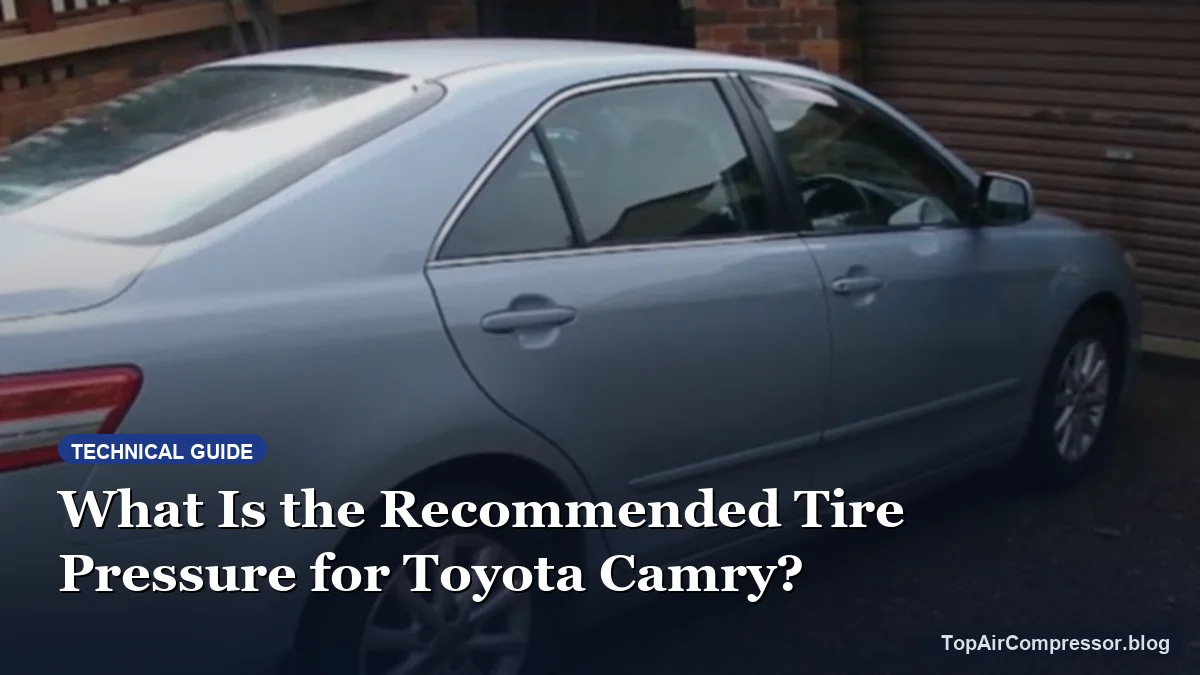
The standard cold tire pressure for most Toyota Camry models ranges between 32 and 35 PSI depending on your exact trim level and wheel size.
Looking for matching picks? See our Best Tire Pressure Inflator: Top Picks Tested for 2026.
Toyota Camry Tire Pressure Reference Matrix
| Trim / Wheel Size | Recommended Cold PSI | Core Technical Purpose |
|---|---|---|
| Base 16-inch wheels | 32 PSI Front / Rear | Standard commuter comfort and efficiency |
| Mid-tier 17-inch wheels | 35 PSI Front / Rear | Balanced handling and load capacity |
| Sport 18-inch wheels | 35 PSI Front / Rear | Enhanced cornering stability and response |
| V6 or Hybrid variants | 35 to 36 PSI | Compensates for added front-end weight |
| Compact Spare Tire | 60 PSI | Ensures emergency load-bearing readiness |
| Winter Cold Drop | Add 1 PSI per 10°F drop | Prevents under-inflation during cold snaps |
Locating and Deciphering the Official Factory Tire Placard
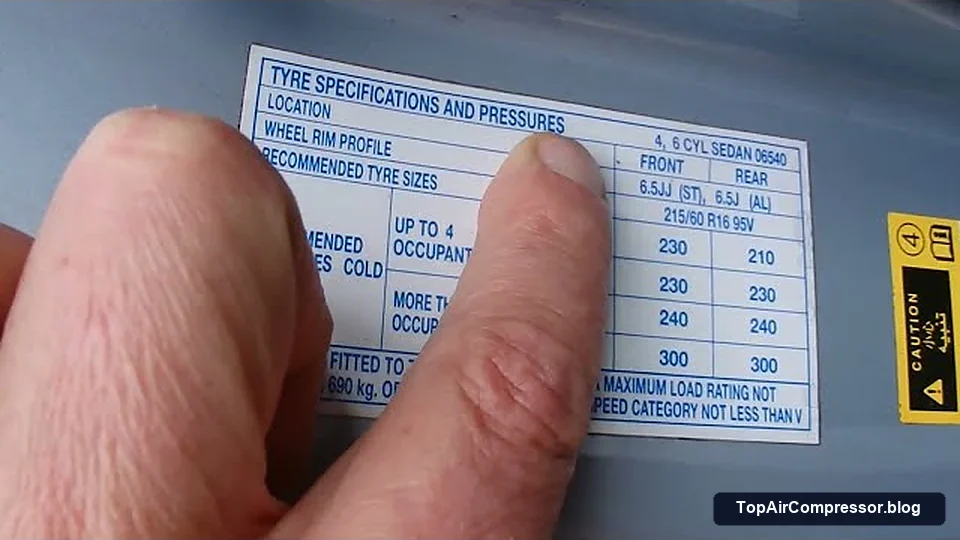
Finding the correct inflation pressure for your specific vehicle requires checking the manufacturer placard. This crucial sticker is permanently affixed to the driver side door jamb.
When you open the driver door, look closely at the center pillar. Larger family vehicles require specific gear found inside our best portable tire inflator for suv resource.
Never rely on guessing or generic online numbers when inflating tires. The vehicle manufacturer engineers these exact figures for optimal braking, cornering stability, and load capacity.
- Locate the federal placard on the driver door pillar.
- Verify your specific vehicle build month and year.
- Check recommended cold PSI for front and rear axles.
- Note the maximum vehicle load capacity limits.
Reading Gross Axle Weight Ratings
The placard lists Gross Axle Weight Ratings alongside tire sizes. These metrics dictate how much weight each individual axle can safely support under maximum operating conditions.
Matching your tire load index to these ratings prevents premature sidewall failure. Always install replacement tires that equal or exceed the original factory load specifications.
- Review maximum weight limits for front axles.
- Confirm rear axle weight distribution thresholds.
Understanding Cold Inflation Definitions
Manufacturers specify cold inflation pressure as the baseline measurement. This means checking your tires after the vehicle has been parked for at least three hours.
Driving friction generates internal heat that artificially inflates tire pressure readings. Always adjust your pressures early in the morning before direct sunlight hits the rubber.
- Allow vehicle to sit for three hours minimum.
- Avoid measuring immediately after highway driving.
Standard Cold PSI Specifications Across Toyota Camry Trims
Different model generations and trim packages utilize varying wheel diameters. Base models featuring smaller wheels often require 32 PSI for smooth daily commuting.
Upgraded sport trims equipped with larger alloy wheels generally require 35 PSI. Finding a versatile unit is simple when you review our best air compressor for the money recommendations.
Hybrid variants demand careful attention due to regenerative braking systems and battery weight distribution. Always verify your specific tire placard rather than assuming uniform pressure.
- Base 16-inch configurations typically target 32 PSI.
- Sport 17 and 18-inch wheels usually require 35 PSI.
- Hybrid editions require precise adherence to door labels.
- Check both front and rear axles for pressure variations.
Accounting for Passenger and Cargo Loads
Factory door placards often list two distinct pressure tiers. Normal loads apply for daily commuting with standard passenger counts and minimal cargo weight.
Maximum load specifications require higher PSI figures. Consult your manual if you are embarking on long road trips with heavy luggage and full seating.
- Identify normal commuter pressure guidelines.
- Locate maximum capacity adjustments when hauling.
Verifying Spare Tire Inflation Levels
Drivers frequently overlook the compact spare tire hidden beneath the trunk floor. Temporary spares operate at much higher pressures, typically 60 PSI.
Inspect your emergency spare during routine monthly maintenance checks. A deflated spare leaves you stranded despite having properly inflated primary road tires.
- Locate compact spare valve stem in trunk.
- Maintain proper temporary high-pressure levels.
Video Walkthrough: Toyota Camry (2018-2024): Recommended Tire Pressure.
Understanding Sidewall Maximums Versus Placard Recommendations
A common technical mistake involves inflating tires to the maximum limit printed on the rubber sidewall. Before running pneumatic tools, always consult our CFM tool sizing calculator for accurate operational metrics.
The tire manufacturer prints the absolute maximum pressure the casing can safely withstand. Inflating your Camry tires to that ceiling creates a harsh ride and center tread wear.
Always follow the vehicle manufacturer placard inside the door jamb. That specification balances comfort, braking distance, fuel economy, and tire lifespan perfectly.
- Sidewall PSI indicates maximum structural capacity.
- Door placard PSI delivers ideal ride and safety.
- Over-inflation reduces tire contact patch significantly.
- Under-inflation generates excessive internal heat buildup.
Dangers of Over-Inflation on Sidewalls
Exceeding recommended pressure causes the tread center to bulge outward. This abnormal footprint reduces traction on wet asphalt and accelerates center tread wear.
Stiff tires transmit sharp impacts directly into suspension components. Over-inflated rubber is also more vulnerable to sudden impact damage from potholes.
- Observe accelerated center tread degradation.
- Minimize harsh impacts on suspension joints.
Risks Associated with Under-Inflation
Low pressure causes excessive sidewall flexing during highway operation. This continuous flexing generates dangerous internal heat that can lead to sudden tread separation.
Under-inflated tires also increase rolling resistance, forcing your engine to burn more fuel. Check pressures monthly to prevent gradual air loss over time.
- Prevent dangerous internal tire heat spikes.
- Maintain optimal fuel efficiency through proper PSI.
Step-by-Step Procedure for Adjusting Tire Pressure Safely
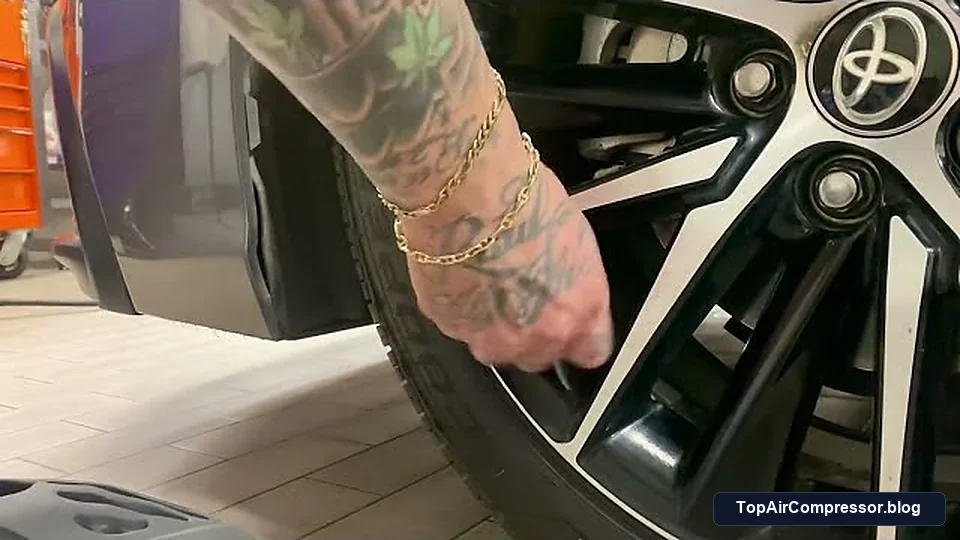
Accurate air pressure maintenance requires a reliable digital or dial pressure gauge. Remove the protective valve stem cap and press the gauge firmly onto the valve.
Listen for a brief hiss of escaping air, which indicates a proper seal. Read the digital display or mechanical dial to determine your current baseline pressure level.
If pressure is too high, use your gauge to bleed air. For heavy-duty vehicles, choose a reliable unit from our best portable tire inflator for trucks guide.
- Remove valve stem cap and store securely.
- Press gauge straight onto valve stem firmly.
- Compare measured PSI against door placard.
- Replace valve stem cap to block moisture.
Using Portable Air Compressors Correctly
Connect your portable 12-volt or direct-drive air compressor to the power source. Secure the chuck onto the tire valve stem with a positive locking latch.
Activate the compressor and monitor the inline pressure gauge closely. Inflate in short bursts to avoid overshooting your target vehicle specification.
- Secure compressor chuck firmly onto valve.
- Monitor gauge closely during active inflation.
Double-Checking Final Readings
Never assume the first reading is completely accurate after inflating. Remove the chuck and take a fresh measurement with your manual handheld gauge.
Ensure all four tires match the specified target placard. Consistent pressure across both axles ensures balanced braking and predictable steering response.
- Take secondary manual pressure measurements.
- Verify uniform pressure across all positions.
Interpreting Dashboard Tire Pressure Monitoring System Warnings
Modern Toyota Camry models feature a direct TPMS monitoring system. When pressure drops twenty-five percent below recommended levels, a dashboard warning illuminates.
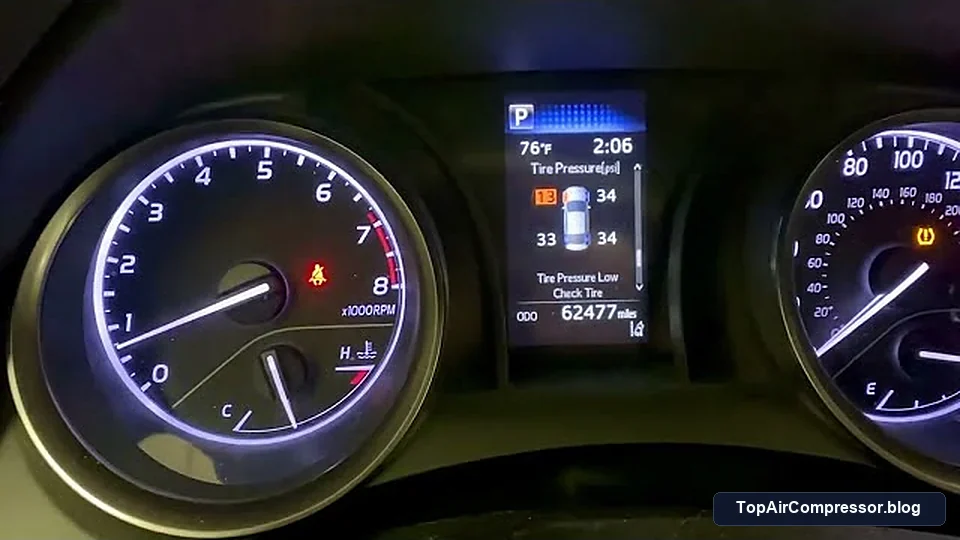
The warning icon resembles a flat cross-section with an exclamation point in the center. Ignoring this indicator compromises emergency stopping distances and vehicle stability.
Temperature drops during seasonal changes frequently trigger this warning light. Cold air contracts rapidly, causing a noticeable drop in overall PSI across all tires.
- Identify the yellow dashboard warning icon.
- Recognize twenty-five percent pressure drop triggers.
- Understand temperature-induced air contraction effects.
- Inspect all four road tires immediately upon alert.
Flashing Versus Solid Warning Indicators
A solid dashboard light indicates low pressure in one or more tires. This requires a simple inflation procedure to restore correct operating levels.
A flashing warning light typically signals a system malfunction. This indicates a dead sensor battery, damaged radio transmitter, or unprogrammed component.
- Solid light points to low inflation levels.
- Flashing light indicates electronic sensor fault.
Advanced Multi-Display Data Screens
Higher Camry trims display exact PSI values for each wheel on the cluster. Scroll through your multi-information display to pinpoint the under-inflated tire.
This eliminates guesswork and speeds up corrective maintenance routines significantly. Review your owner manual for specific steering wheel button navigation steps.
- Access multi-information display cluster menus.
- Identify individual wheel pressure readouts.
Video Walkthrough: What Is The Correct Tire Pressure For Your Car? Fast \u0026 Easy!
Relearning and Resetting the Camry TPMS After Inflation
After adjusting your tire pressures to factory specifications, you must calibrate the monitoring system. Locate the TPMS reset button, typically positioned beneath the steering wheel.
Turn your ignition switch to the ON position without starting the engine. Press and hold the reset button until the dashboard indicator blinks slowly.
Allow the vehicle to remain parked or drive steadily for twenty minutes. This lets the sensors transmit updated baseline calibration data to the main computer.
- Locate physical reset button under dashboard.
- Switch ignition to ON without cranking engine.
- Hold reset switch until indicator blinks thrice.
- Complete calibration drive to finalize storage.
Using Infotainment Menu Reset Procedures
Recent Camry model years manage system resets through the touchscreen. Navigate to the vehicle settings menu and select the tpms calibration utility.
Confirm the initialization prompt to store current pressure baselines. The system will record your new operating pressures automatically within a few minutes.
- Access touchscreen vehicle settings menus.
- Select calibration and confirm initialization.
Troubleshooting Persistent Warning Lights
If the warning light persists after calibration, check your spare tire pressure. Many Toyota systems monitor the compact spare as part of the safety network.
Defective sensor batteries require professional replacement by a tire technician. Sensors typically last between five and ten years before internal cells deplete.
- Verify spare tire pressure includes monitoring.
- Schedule sensor replacement for dead batteries.
Seasonal Temperature Fluctuations and Year-Round Pressure Maintenance
Ambient air temperature directly impacts internal tire pressure metrics. For every ten degree Fahrenheit drop in outdoor temperature, tires lose roughly one PSI.
Autumn and winter cold snaps frequently catch drivers off guard with morning warning lights. Compensate by checking pressures monthly as seasons transition.
Conversely, summer heat waves increase internal pressure as air expands. Never bleed air from hot tires during summer unless pressure exceeds safe limits.
- Account for one PSI loss per ten-degree drop.
- Inspect pressures during seasonal weather shifts.
- Avoid bleeding hot tires during summer heat.
- Perform monthly maintenance checks consistently.
Winter Weather Inflation Strategies
Add one to two extra PSI during deep winter freezes. This proactive adjustment offsets extreme morning temperature drops and prevents nuisance warning alerts.
Park in a garage when checking pressures if possible. Measuring rubber at ambient indoor temperatures ensures precise baseline calibration results.
- Add minor padding for deep winter freezes.
- Measure in sheltered garages when possible.
Summer Highway Heat Management
High-speed highway driving in summer generates extreme internal tire heat. Normal operating pressures will rise naturally during extended road trips.
Trust your initial cold pressure measurements taken in the morning. Do not let temporary warm weather pressure increases cause unnecessary panic.
- Expect natural pressure rises at highway speeds.
- Rely strictly on cold morning baseline checks.
Critical Safety and Efficiency Benefits of Correct Inflation
Maintaining precise tire pressure maximizes your vehicle safety envelope. Correctly inflated tires deliver shorter emergency stopping distances on wet and dry pavement.
Proper contact patch geometry ensures stable cornering and predictable handling limits. This prevents dangerous skids during sudden obstacle avoidance maneuvers.
Fuel economy also improves significantly when rolling resistance remains minimal. Over-taxed engines burning extra fuel due to low pressure cost money at the pump.
- Achieve shorter emergency braking distances.
- Maintain stable cornering and steering control.
- Optimize fuel efficiency by reducing drag.
- Extend total operational lifespan of treads.
Preventing Premature Tread Wear Patterns
Incorrect inflation ruins expensive tire investments prematurely. Under-inflation destroys outer shoulders, while over-inflation destroys center tread bands.
Balanced pressure distributes vehicle weight evenly across the entire contact patch. This promotes even tread wear and maximizes total mileage potential.
- Prevent shoulder wear from low pressure.
- Ensure even weight distribution across tread.
Environmental and Economic Advantages
Properly inflated tires reduce carbon emissions through optimal fuel burn. Conserving rubber through even wear reduces landfill waste from premature replacements.
Routine monthly maintenance requires minimal effort while delivering substantial financial savings. Protect your investment with consistent pressure management habits.
- Lower vehicle emissions through efficiency.
- Maximize financial return on tire purchases.
Frequently Asked Questions
What is the standard recommended tire pressure for a Toyota Camry?
Most Toyota Camry models require between 32 and 35 PSI for cold tires. Always verify the exact specification printed on your driver door jamb placard.
Should I inflate my Camry tires to the pressure listed on the sidewall?
No, never use the sidewall PSI rating. That figure represents the maximum structural limit, whereas the door placard provides the ideal balance for safety.
Why does my Camry tire pressure warning light come on during cold weather?
Ambient temperature drops cause internal air to contract. Tires lose roughly one PSI for every ten-degree drop in outdoor temperature, triggering the alert.
How do I reset the TPMS light on my Toyota Camry after adding air?
Locate the reset button beneath the steering wheel or use the touchscreen menu. Turn the ignition on, press and hold the button until it blinks.
When is the best time of day to check my Toyota Camry tire pressure?
Check your tires early in the morning before driving. This ensures the rubber is cold and gives you an accurate baseline pressure measurement.