What Size Air Hose Do I Need?
Selecting the correct air hose diameter ensures peak pneumatic tool performance and prevents excessive pressure drop. Proper sizing balances internal volume and friction loss for your specific setup.

Match your hose inner diameter directly to your tool's maximum CFM and operating distance. Using a 3/8-inch inner diameter hose resolves most standard workshop and automotive air flow restrictions.
Looking for matching picks? See our Best Size Air Hose For Framing Nailer: Top Picks.
Practical Quick-Reference Table
| Scenario / Metric | Recommended Target | Why It Matters |
|---|---|---|
| Light brad nailers | 1/4-inch inner diameter | Low CFM draw requires minimal volume. |
| Standard impact wrenches | 3/8-inch inner diameter | Prevents severe pressure drops under load. |
| High-demand sanders | 1/2-inch inner diameter | Ensures continuous high airflow for motors. |
| Hoses under 25 feet | 1/4-inch acceptable | Short runs minimize internal friction losses. |
| Hoses over 50 feet | 3/8 or 1/2-inch required | Longer runs amplify standard pressure drops. |
| Maximum safe pressure | 300 PSI rating limit | Protects against sudden pneumatic burst failures. |
Decoding Pneumatic Inner Diameters And Volumetric Flow
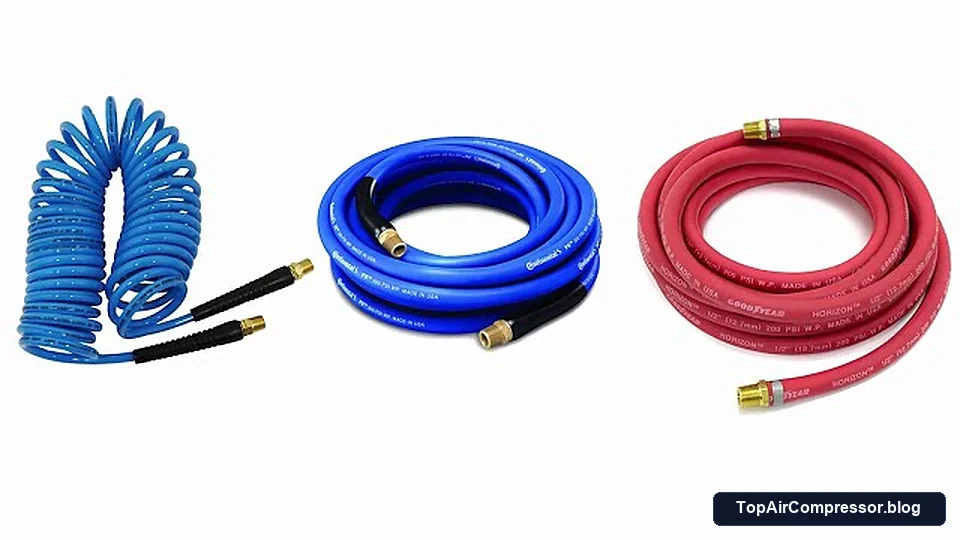
Understanding air hose sizing requires looking closely at the internal diameter rather than external measurements. The inner diameter dictates how much volume can travel freely without encountering severe friction walls.
Smaller hoses restrict the flow of compressed air, leading to noticeable pressure drops at the tool inlet. Operating pneumatic equipment with restricted flow reduces impact force and motor torque.
Manufacturers design hoses using specific rubber, polyurethane, or hybrid polymer compounds. Each material influences flexibility, weight, and inner wall smoothness, which directly affects overall volumetric efficiency during heavy usage.
Selecting an incorrect hose diameter creates artificial bottlenecks within your pneumatic circuit. Explore our best air hose for air compressor selections to maintain optimal airflow during heavy shop tasks.
Choosing the correct inner diameter dictates how much compressed air reaches your pneumatic tool without suffering severe frictional resistance or starvation inside the flexible rubber or polyurethane conduit wall matrix.
A one-quarter inch hose restricts high-volume tools like impact wrenches, forcing compressors to work harder while delivering inadequate CFM levels needed for sustained peak torque performance under heavy load conditions.
Upgrading to a three-eighths inch variant drastically reduces internal friction, allowing proper volumetric flow rates to maintain consistent operating pressure at the tool inlet during continuous industrial applications.
Engineers calculate flow capacity using standardized Pneumatic and Hydraulic formulas where inner cross-sectional area directly scales with maximum allowable air velocity before turbulent pressure drops ruin efficiency.
- Always measure pneumatic hoses by their internal diameter.
- Smooth inner walls reduce turbulence and internal air friction.
- Polyurethane offers great kink resistance and high flexibility.
- Rubber provides superior durability in harsh jobsite environments.
Evaluating Material Compositions
Different hose materials handle ambient temperatures and physical stress uniquely across varying jobsite conditions. Hybrid polymer blends combine lightweight handling with exceptional burst strength for professional workshop settings.
Rigid thermoplastic lines can stiffen significantly during cold weather operations, making them difficult to coil. Premium rubber options maintain flexibility below freezing temperatures while resisting oil contamination.
- Check temperature ratings before winter outdoor work.
- Avoid dragging thermoplastic lines across sharp concrete edges.
Matching Hose Internal Width To Tool Air Consumption
Every pneumatic tool demands a specific volume of compressed air measured in cubic feet per minute. Matching your hose internal width to this demand prevents frustrating tool starvation during critical tasks.
Brad nailers and staplers consume very little air, making narrow lines completely acceptable for trim work. High-consumption tools like grinders and sanders require much wider passages to maintain continuous operation.
Ignoring tool CFM requirements leads to sluggish performance and overheated pneumatic motor components. Evaluating peak consumption ratings helps you select a diameter that supports sustained operational cycles.
When operating multiple tools from a single compressor line, aggregate CFM requirements dictate mainline sizing. Main distribution lines must be substantially wider than individual whip hoses attached to tools.
Every pneumatic tool specifies an average CFM rating at ninety pounds per square inch, requiring your supply line to match these specific volumetric demands to prevent operational lag.
Die grinders and sanders demand massive continuous airflow, meaning a restrictive quarter-inch line will cause immediate motor overheating and premature mechanical failure due to severe pressure starvation.
Brad nailers consume minimal air, making a lightweight slim diameter hose ideal for mobility and reducing wrist fatigue during overhead finish carpentry and delicate trim installation tasks.
Always size your main trunk line properly, and consult our best size air hose for framing nailer recommendations to ensure heavy nailers receive maximum volumetric efficiency without dangerous pressure drops.
- Check manufacturer CFM specifications for every active tool.
- Sum total air requirements when running multiple devices simultaneously.
- Never feed high-CFM sanders through restrictive narrow lines.
- Use larger whip hoses directly connected to high-draw impacts.
Balancing Tool Duty Cycles
Intermittent tools like impact wrenches tolerate minor pressure drops during brief fastener installation bursts. Continuous-duty tools demand steady, uninhibited airflow to prevent thermal overload and premature mechanical wear.
Calculated pressure drops should never exceed ten percent of your total compressor output pressure. Maintaining stable pressure guarantees consistent fastener depth and reliable rotary motor speeds.
- Monitor pressure gauges during heavy tool operation.
- Account for intermittent versus continuous operational demands.
Video Walkthrough: How Much Power Are You Losing w/ Your Air Hose Size? Dyno Graph Testing
Evaluating Total Run Length And Pressure Drop Dynamics
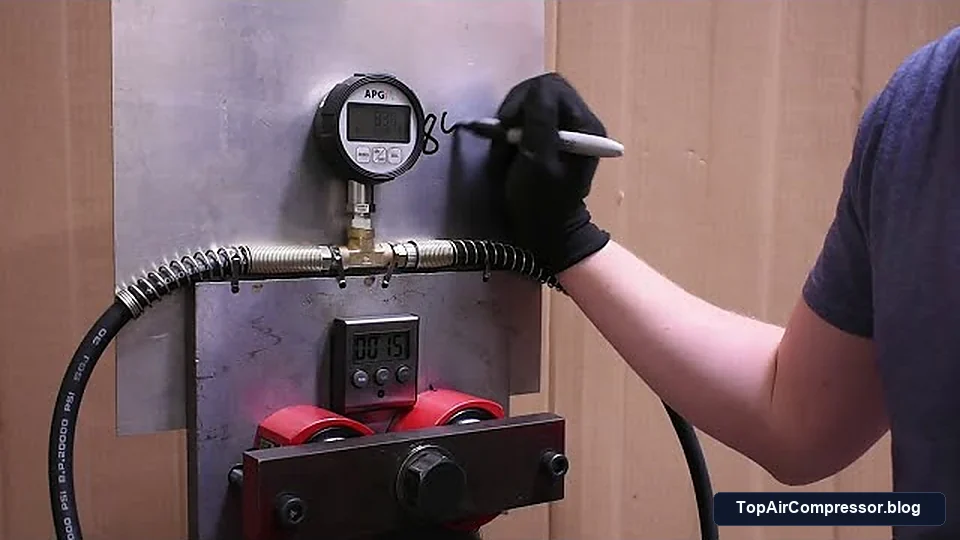
Hose length plays a massive role in delivery efficiency. Review our best air hose guide to understand how friction losses accumulate rapidly along internal conduit walls.
A twenty-five-foot line allows higher airflow efficiency compared to a fifty-foot line of identical width. Extending your total hose length requires stepping up your inner diameter to compensate for resistance.
Physics dictates that pressure drops increase proportionally with total distance and flow velocity. Designing your workshop layout with strategic drop locations minimizes excessive hose lengths entirely.
Connecting multiple short hoses together introduces additional fitting restrictions that compound pressure drops. Using a single continuous run of appropriate diameter eliminates these unnecessary pneumatic bottlenecks.
Friction against inner hose walls causes pressure drop, a measurable loss of PSI that increases exponentially as you extend the total length of your compressed air delivery circuit.
Standard industry guidelines recommend limiting individual runs to fifty feet unless you increase the hose diameter to compensate for the cumulative frictional drag along the inner walls.
Combining multiple hoses with small couplers creates severe restriction bottlenecks, compounding pressure losses and robbing your pneumatic equipment of necessary operating force at the business end.
Installing a larger lead hose near the compressor helps mitigate early pressure decay before routing air through longer, more flexible drops positioned around your active workstations.
- Keep total hose runs as short as practically possible.
- Step up hose diameter when exceeding fifty feet of length.
- Avoid linking multiple short hoses with restrictive couplers.
- Calculate friction loss when designing complex shop layouts.
Calculating Distance Thresholds
Standard workshop setups function efficiently with twenty-five to fifty-foot lines of moderate width. Industrial applications spanning over one hundred feet require significantly larger trunk lines to maintain tool pressure.
Always evaluate the distance from your tank regulator directly to the working tool inlet. Ignoring intermediate connectors can introduce hidden restrictions that degrade overall system performance.
- Measure exact distances between compressor and workstation.
- Upgrade diameter when expanding shop operating perimeters.
Calculating Peak Pneumatic Demand For Heavy Duty Work
Heavy-duty industrial applications demand rigorous calculations to determine exact airflow requirements and sizing thresholds. Assessing peak pneumatic demand ensures your distribution network avoids catastrophic pressure starvation under load.
High-torque impact wrenches and grinders consume massive volumes of air instantly. Use our cfm & tank sizing calculator to match precise tool requirements without stalling motors.
Undersized lines cause compressors to work harder while delivering lower effective pressure at the tool. This inefficiency increases electrical power consumption and accelerates wear on compressor pump components.
Consulting comprehensive flow charts helps professionals select correct pipe and hose sizes accurately. Proper engineering calculations prevent costly trial-and-error adjustments in busy commercial workshops.
Heavy-duty automotive shops operating multiple air tools simultaneously must calculate peak demand by summing individual CFM requirements and applying a realistic simultaneous usage duty factor percentage.
Main distribution headers require robust industrial piping or wide-diameter hoses to supply multiple workstations without starving downstream technicians of required volumetric flow during peak shift hours.
Failing to account for simultaneous operation leads to cascading pressure drops, rendering heavy impact guns sluggish and frustrating technicians trying to complete high-volume production assembly tasks.
Professional facility managers always specify an oversized manifold system to accommodate future tool additions without requiring a complete overhaul of the existing compressed air infrastructure.
- Factor in simultaneous tool usage during peak operating hours.
- Consult standardized pneumatic flow charts for precise sizing.
- Prioritize larger diameters for heavy rotational equipment.
- Protect compressor pumps from excessive continuous loading cycles.
Industrial Flow Calculations
Complex facilities utilize rigid header pipes before stepping down to flexible drop lines. Engineers calculate friction coefficients across valves, bends, and couplers to maintain optimal operating pressures throughout.
Verify that your compressor receiver tank capacity matches high-demand tool duty cycles. Adequate storage volume helps buffer short peak demands before pressure drops affect tools.
- Include valves and bends in friction loss equations.
- Verify receiver tank capacity supports peak tool surges.
Selecting Proper Fittings Couplers And Restrictive Hardware
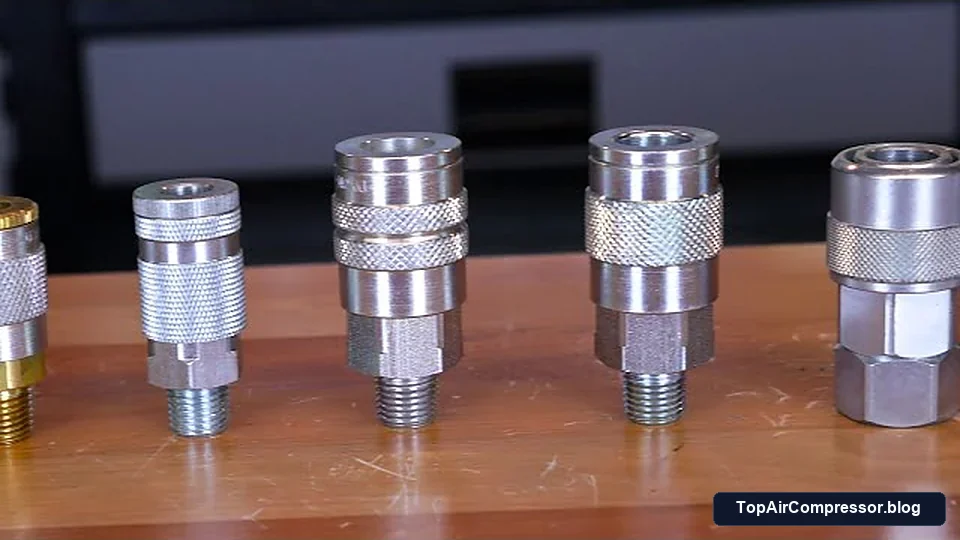
Fittings and quick-disconnect couplers act as critical transition points within any pneumatic circuit layout. Choosing high-flow couplers prevents unexpected restrictions that negate the benefits of a wide hose.
Standard industrial fittings often feature narrow internal passages that restrict maximum airflow significantly. Upgrading to automotive or high-flow style connectors improves volume delivery across your entire setup.
Hose barb sizes must match the internal diameter of your selected hose precisely. Improperly matched clamps or barbs create turbulence points that collect debris and cause air leaks.
Inspect all mechanical connections regularly for signs of wear, distortion, or minor air leakage. Even small leaks waste compressed air and reduce the overall efficiency of your system.
High-flow quick-connect couplers are essential because standard automotive-style fittings often feature tiny internal orifices that severely restrict CFM delivery despite using a wide hose.
Inspecting fitting internal diameters ensures you do not inadvertently bottleneck airflow right before it enters the tool housing, negating the benefits of your wide distribution line.
Brass and steel swivel fittings reduce operator wrist strain while maintaining secure, leak-free connections under vibrating loads common in heavy manufacturing and professional construction environments.
Thread sealant compounds must be applied carefully to prevent excess tape from breaking loose and creating downstream blockages inside delicate pneumatic valves and internal motor components.
- Match quick-disconnect body sizes to your hose diameter.
- Use high-flow fittings for high-CFM pneumatic tools.
- Secure hose clamps firmly to prevent slip-offs under pressure.
- Replace worn O-rings inside couplers to eliminate air leaks.
Evaluating Coupler Styles
Industrial interchange, Milton style, and Aro couplers offer distinct flow characteristics and interchangeability. Selecting a universal high-flow profile maximizes compatibility while maintaining unrestricted air delivery performance.
Avoid mixing different coupler brands when strict airflow volume is required for heavy tools. Consistency across your quick-disconnect hardware prevents unexpected internal flow restrictions.
- Standardize coupler profiles across your workshop.
- Avoid restrictive multi-adapter fittings on primary lines.
Implementing Safe Maintenance Practices For Long Hose Life
Routine maintenance extends the operational lifespan of pneumatic hoses and prevents sudden blowout hazards. Inspecting your outer hose jacket regularly identifies abrasions, cracks, or deep bulges early.
Store air hoses loosely coiled on dedicated wall hangers rather than sharp hooks. Proper storage prevents permanent kinks that weaken internal reinforcement braids and cause structural failures.
Keep hoses away from hot welding sparks, sharp metal shards, and heavy vehicle traffic zones. Protective covers or hose ramps shield lines from crushing damage in busy automotive shops.
Drain your compressor tank daily to prevent moisture accumulation from entering the air lines. Water inside hoses can degrade inner linings and damage sensitive pneumatic tool mechanisms over time.
Regular visual inspections help identify abrasion wear, bulges, or dry rot on rubber and hybrid polymer lines before catastrophic rupture occurs under high working pressures.
Storing lines on spring-loaded reels prevents kinks and structural damage caused by heavy equipment running over unprotected hoses stretched across active concrete shop floors.
Draining compressor tanks daily prevents moisture accumulation from degrading the hose inner liner from the inside out, protecting your air distribution network from premature failure.
Operating lines within their certified maximum PSI rating ensures safe workplace conditions and complies with OSHA regulations regarding pressurized flexible pneumatic equipment handling standards.
- Store hoses on smooth wall reels or hanging brackets.
- Protect lines from hot welding sparks and sharp edges.
- Drain compressor moisture traps daily to protect hoses.
- Retire any hose showing internal braid exposure or bulges.
Storage And Handling Protocols
Proper coiling technique prevents twisting stresses that damage internal reinforcement fibers over time. Never yank a stuck hose forcefully around corners, as this creates extreme friction and structural strain.
Test maximum working pressure limits periodically to ensure aging lines remain safe for use. Discard any hose that exhibits soft spots or persistent air seepage through the jacket.
- Coil hoses naturally to avoid internal twisting stress.
- Walk down extended lines to clear snags safely.
Troubleshooting Common Air Starvation And Pressure Loss Issues
Diagnosing tool sluggishness begins by measuring working pressure directly at the tool inlet. Finding a significant pressure drop under load usually points to an undersized or restricted hose.
Check for internal blockages, collapsed inner walls, or clogged quick-disconnect fittings along the line. Clearing or replacing damaged components immediately restores normal tool performance and operational torque.
Verify that your compressor regulator is adjusted correctly for the specific task at hand. Incorrect regulator settings can mimic symptoms of hose restriction even when proper diameters are used.
Isolate sections of your pneumatic network to pinpoint exact locations causing pressure drops. Systematic troubleshooting saves time and eliminates unnecessary component replacements across your workshop setup.
Diagnosing sluggish tool performance begins with checking dynamic pressure at the inlet using a gauge attachment while the tool operates under a normal working load.
If pressure drops significantly during operation, inspect your entire line for internal obstructions, collapsed inner walls, or undersized connector orifices restricting volumetric airflow.
Replacing restrictive components with high-flow accessories instantly restores lost torque and RPM, resolving common pneumatic starvation issues without purchasing a larger air compressor unit.
Documenting baseline pressure readings across different workstations helps maintenance teams catch minor restrictions before they escalate into costly production downtime or equipment damage events.
- Measure air pressure dynamically while the tool runs.
- Inspect quick-disconnect valves for internal debris buildup.
- Verify regulator calibration before replacing supply lines.
- Isolate individual hose segments to locate restrictions.
Diagnostic Testing Steps
Attach a static pressure gauge at the compressor tank, then take a second reading at the tool end. The variance between these measurements reveals your actual operating friction loss under load.
Clean dirty couplers using approved solvent sprays and compressed air blasts before reconnecting. Replacing worn internal valves often resolves intermittent air delivery failures instantly.
- Use dual pressure gauges to check dynamic drops.
- Clean contaminated quick-connect valves thoroughly.
Frequently Asked Questions
Can I use a 1/4-inch hose for all my air tools?
A 1/4-inch hose works well for low-CFM devices like brad nailers and inflation chucks. However, using it with high-draw tools causes severe pressure drops and reduces performance.
How does hose length affect my tool operating pressure?
Longer hoses increase internal friction resistance, which lowers effective pressure at the tool end. Stepping up your inner diameter size compensates for distance friction losses.
What is the best hose diameter for standard impact wrenches?
A 3/8-inch inner diameter hose provides the ideal balance for most standard impact wrenches. This size delivers adequate airflow to prevent torque loss during heavy fastening tasks.
Do quick-disconnect fittings restrict airflow in my air line?
Standard fittings often feature narrow internal passages that create noticeable airflow restrictions. Upgrading to high-flow connectors eliminates bottlenecks and improves overall pneumatic tool efficiency.
Why is my air hose getting stiff during winter weather?
Certain thermoplastic hose materials harden significantly when exposed to freezing ambient temperatures. Selecting flexible hybrid polymer options prevents kinking and maintains easy handling outdoors.